The handover that isn't written down
A chief engineer spends eighteen months aboard a 45-metre motor yacht. In that time they learn that the port generator runs hot under a particular load combination, that the starboard watermaker needs its membrane flushed in a specific sequence or it cavitates, and that the hull transducer reports false depths in water below eight degrees. They know which chandlery actually stocks the right oil filters without a six-week lead time, and which shore electrician understands the vessel's inverter setup.
None of this is in the planned-maintenance system. It isn't in the equipment manuals. In most cases it isn't in any handover document either, because no structured handover document exists. It lives in one person's head and one person's phone.
When that engineer leaves, the knowledge leaves with them.
The incoming engineer arrives, often with a week of overlap or less. A Seahub industry survey found that 66% of engineering handovers last one week or less, with the outgoing engineer frequently departing before the overlap period concludes [1]. What transfers in that window is mechanical — where the tools are, how to start the generators, which valves are normally open. What does not transfer is context: the operational memory that separates competent vessel management from reactive troubleshooting.
The rotation reality: a fleet that forgets every two years
Superyacht crew move frequently. The industry standard for senior engineering positions is a rotational contract — nine in ten chief engineers work time-for-time or a similar schedule [2]. Junior turnover runs higher: Quay Group data shows an average annual turnover rate of 37% among entry-level deck and interior positions [3]. For senior crew, one to two years aboard is considered a solid tenure; beyond two years is uncommon, though recruitment professionals recommend it [4].
The arithmetic is unforgiving. A vessel's engineering team can change entirely inside a two-to-three-year cycle, and each transition is another chance to lose operational context. Across a fleet, the effect compounds: the same faults get diagnosed twice, the same supplier mistakes get repeated, the same warranty claims get denied — not because the information never existed, but because it walked off with the person who held it.
What actually disappears
The loss is not abstract. It is specific, measurable, and expensive.
Fault history and what it cost to solve
The previous engineer diagnosed a vibration in the port engine fourteen months ago. It was a coupling-alignment problem, resolved in four hours with a specific procedure. Without that record, the next engineer calls a marine technician — a callout running into several thousand euros depending on location and urgency, for a fault that was already solved once [5]. The cost is not the repair. The cost is paying to learn something the vessel already knew.
Supplier and maintenance nuance
Planned-maintenance systems record that a task was completed. They do not record that it required a workaround because the original part is discontinued, or that the manufacturer's torque specification fails the gasket on this particular installation. The gap between a maintenance log and operational memory is the gap between a record and an understanding.
Warranty evidence
Equipment manufacturers require documented evidence of maintenance performed to specification. A denied warranty claim on a single piece of marine equipment can run from tens of thousands of euros into six figures [6]. When the engineer who did the work is gone and the records are incomplete, the owner absorbs the loss.
Retaining institutional memory when crew rotate
Hill Robinson, one of the largest yacht-management companies, has named the crew skills shortage and high turnover as a systemic industry challenge, noting that experienced professionals leave for shore roles without structured pathways that retain their expertise [7]. The problem is acknowledged at management level. The fix, in most cases, has not kept pace.
The structural issue is that most tools treat maintenance as a series of isolated events. A work order is closed. A part is replaced. A certificate is renewed. Each is logged on its own. But the connections between them — the fault that led to the work order, the part substituted because the original was unavailable, the certificate expiring three months after the next rotation — are captured in no system. They exist only in the engineer's head, and the head leaves on a Tuesday.
Solving this is a design problem more than a technology one. The information already exists — in maintenance logs, fault reports, parts invoices, email threads with manufacturers. It fails because it exists in fragments, scattered across systems that do not talk to each other, in formats nobody can search, tied to individuals rather than to the vessel.
What a real handover has to carry
A handover that survives a rotation has to do three things the typical one-week walkaround cannot.
It has to be a record, not a recollection. The departing engineer should not be the single source of truth about what is outstanding. The defects, the parts on order, the half-finished jobs, the certificate that expires next quarter — these belong in a structure the vessel keeps, not in a memory that boards a flight home.
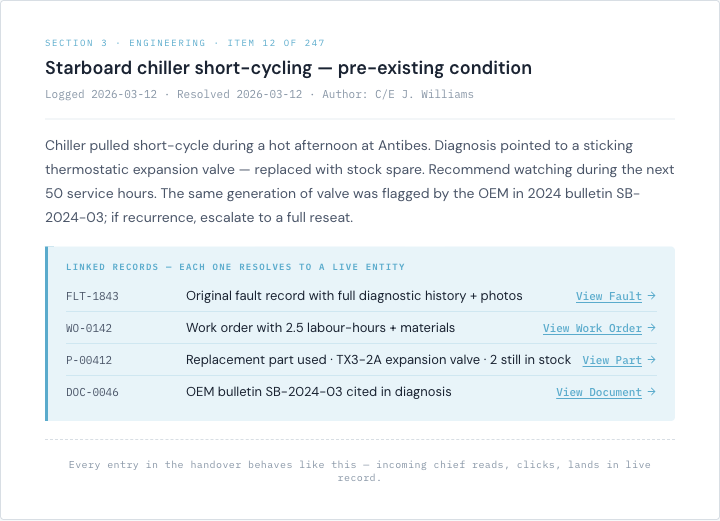
It has to resolve back to the underlying work. A line in a handover that says "watch the starboard chiller" is worth less than the fault it refers to, the work order that addressed it, the part that was fitted, and the manufacturer bulletin cited in the diagnosis. A useful handover is an index into the vessel's operational data, not a flat summary of it.
And it has to be searchable by the person inheriting it. The incoming engineer should be able to ask a plain question — about the oil leak, the generator, the watermaker — and land on the actual record, not navigate a menu tree hoping the previous crew filed things where they would have. The point is not to replace the engineer's judgement, but to make sure the by-product of a year's normal work does not evaporate at the gangway.
Capturing context as the work happens
The most reliable handover is the one that was never a separate task. Every record an engineer closes — a fault, a work order, a note — offers a single tap to add it to the handover draft. The draft accumulates as the engineer works. Months of context build up as a by-product of normal work, rather than being reconstructed from memory in a panic the week before crew change.
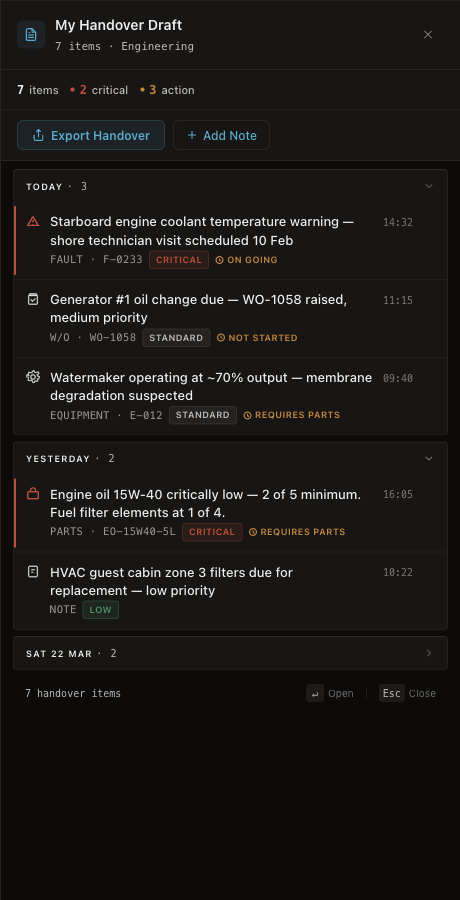
When the rotation comes, the draft is reviewed, not written from scratch. The outgoing engineer reviews it and signs. The incoming engineer acknowledges, in writing, that they have read and understood the operational state of the vessel. Both signatures are timestamped, and the handover is locked after dual signature. The discipline is deliberately plain: it is captured as you work, then reviewed and signed by both parties — nothing claims to write itself.
Every entry resolves to a live record
What makes the handover hold its value is that each entry stays connected to the work behind it. Open a single line — a starboard chiller short-cycling — and the original fault, the work order with its labour hours, the replacement part, and the OEM bulletin cited in the diagnosis are each one click away. The incoming engineer reads the line, follows it, and lands inside the live record itself.
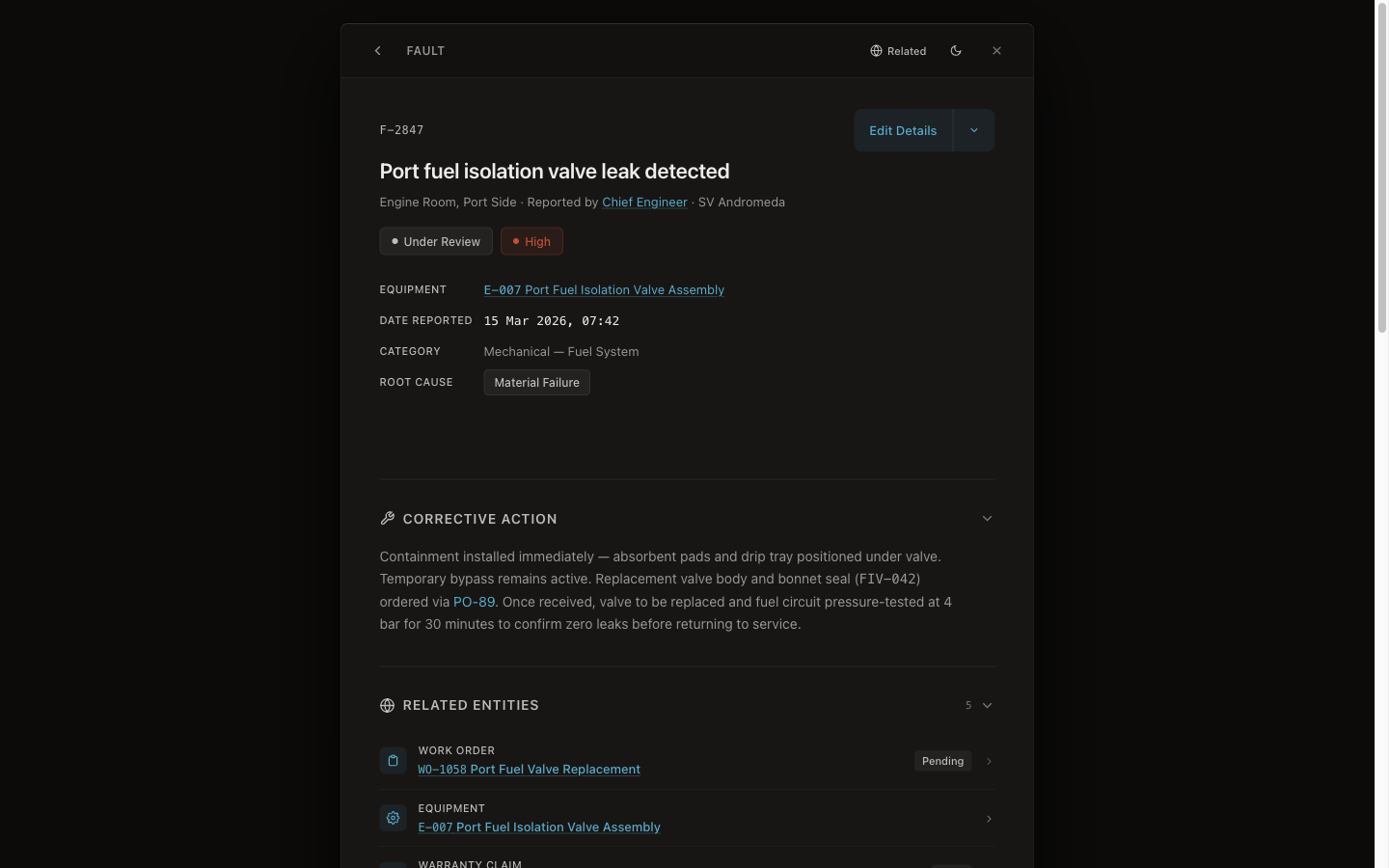
The same connection works from any record, not just the handover. Open the fault and what's related surfaces alongside it — the work order, the equipment, the warranty claim — so the engineer who inherited the boat can follow one thread to every record connected to it, without leaving the page or knowing where anything was filed.
The audit trail that survives the crew
Institutional memory is not only about the next engineer. It is also about being able to prove, later, what was done and by whom. Every action — logging a fault, creating a work order, signing a handover — is attributed by signed-in user and role, and timestamped. The trail is append-only: nothing is overwritten, corrections are recorded as new entries that reference the original, and the original remains intact.
That matters most exactly when crew have rotated. A vessel that cannot produce complete maintenance records during a flag-state or Port State Control inspection faces deficiencies; one that cannot demonstrate a structured handover signals operational risk to an auditor or an underwriter. An audit trail that holds across rotations turns inspection prep from an assembly job into a retrieval one. For deeper detail on how an append-only audit trail stands up under inspection, see our companion piece.
This is where the name on the page matters less than the discipline behind it. CelesteOS is built so the vessel keeps its own memory: records captured as the crew works, connected to each other, searchable in plain language, and attributable when someone asks who did what and when. It runs alongside the existing planned-maintenance system — nothing to replace, nothing to migrate — and the records it holds are independently verifiable at verifier.celeste7.ai. You can also search the vessel's records and manuals in plain language, the way the incoming engineer would actually ask.
Frequently asked questions
How much operational knowledge is actually lost at a crew change?
Enough to pay for it twice. With most engineering handovers lasting a week or less, what transfers is mechanical — where things are, how to start them. What does not transfer is fault history, supplier knowledge, and maintenance nuance, which live in the departing engineer's head. The visible cost shows up later as repeated diagnostic callouts and denied warranty claims on faults the vessel had already solved.
What should a chief engineer's handover include?
Outstanding defects, parts on order, half-finished jobs, certificate expiry dates that fall after the rotation, and the operational notes that explain why things are done a particular way on this vessel. Critically, each item should resolve back to its underlying record rather than living as a flat summary. We cover the structure in detail in our guide to a proper engineering handover.
Does the ISM Code require knowledge transfer between crew?
The ISM Code requires vessels to keep records of maintenance activity and to inspect equipment at appropriate intervals [8]. That is a documentation minimum, not a knowledge-management standard. The Code requires that records exist; it does not require that they be searchable, connected, or transferable to the next crew — which is precisely where institutional memory is lost.
Can software prevent knowledge from walking off the boat?
Not on its own, and any tool claiming otherwise is overselling. What software can do is make sure the by-product of normal work stays with the vessel: capturing records as the engineer closes them, keeping them connected, and making them searchable for whoever inherits the boat. The judgement stays with the engineer. The record stays with the vessel.
Summary
- Crew rotation is a recurring knowledge-loss event; an engineering team can turn over entirely within two to three years.
- What disappears is operational context — fault history, supplier knowledge, maintenance nuance — rarely captured by existing systems.
- The financial cost is concrete: repeated diagnostic callouts running into thousands of euros, and denied warranty claims that reach six figures per incident.
- A handover that survives a rotation must be a record not a recollection, resolve back to the live work, and be searchable by the next engineer.
- The fix is structural: tie the vessel's knowledge to the vessel, captured as the crew works, connected, attributable, and independently verifiable.
CelesteOS keeps a superyacht's operational knowledge in the vessel — maintenance records, fault history, parts, and handovers, connected and searchable, so context does not leave on the next flight home. Learn about the pilot.
[1] Seahub, "Superyacht Engineering Handover: Good, Bad or Essential?" — seahubsoftware.com
[2] YPI Crew, "Superyacht Engineer Salary Guide 2026" — ypicrew.com
[3] Megayacht News, "Why Your Junior Superyacht Crew Are Quitting" — megayachtnews.com
[4] The Triton, "The Yacht Crew Longevity Equation" — the-triton.com
[5] Boat International, "The hidden costs of owning a yacht" — boatinternational.com
[6] YATCO, "Boat Warranty & Yacht Guarantees: What's Covered, Costs & Claim Process" — yatco.com
[7] Hill Robinson, "Addressing the crew skills shortage in the superyacht industry" — hillrobinson.com
[8] IMO, International Safety Management (ISM) Code, Section 10 — marineinsight.com