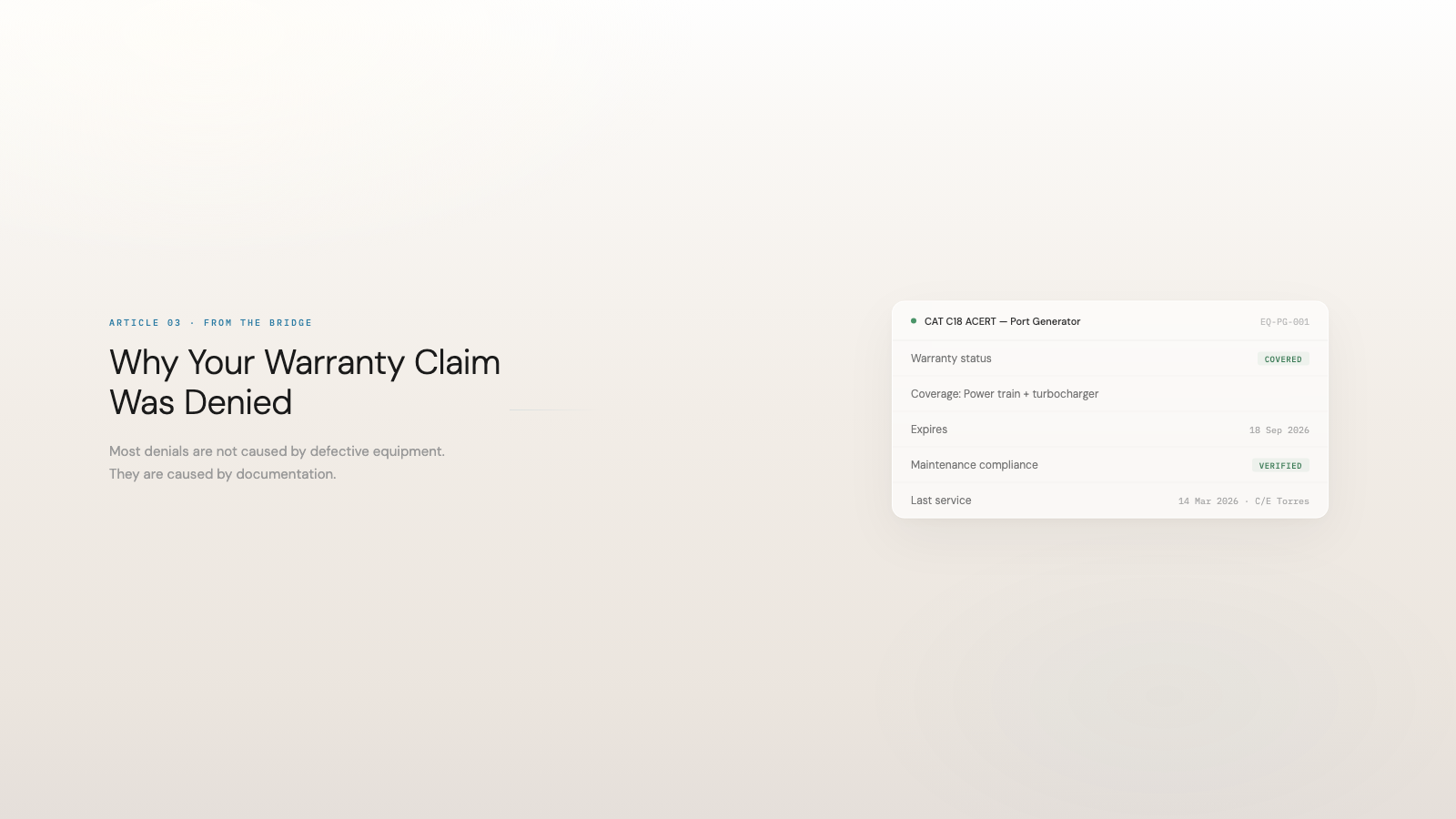
What a denied superyacht warranty claim actually costs
Warranty disputes are among the most common cases in the superyacht industry. Brookes Bell, a maritime technical consultancy that investigates high-value disputes across the sector, identifies three primary drivers: manufacturing defects, installation errors, and material failures [1]. Each of these categories involves equipment where maintenance documentation is central to determining liability.
The financial exposure is significant. A turbocharger failure, a generator control unit malfunction, a gearbox bearing collapse — any single component failure on marine-grade machinery can generate a claim in the EUR 20,000 to EUR 100,000 range [2]. When the manufacturer denies the claim, that cost transfers directly to the vessel owner.
The critical detail that many vessel operators discover too late: the burden of proof lies with the owner, not the manufacturer [2]. The manufacturer does not need to prove the equipment was poorly maintained. The owner needs to prove it was properly maintained. And that proof must be documented, timestamped, and attributable to a specific engineer on a specific date.
Five documentation failures that kill superyacht warranty claims
Warranty claim denials follow predictable patterns. The equipment fails. The engineer files a claim. The manufacturer requests maintenance records. And then one of five documentation failures ends the conversation.
Missing or incomplete maintenance logsThe absence of documented evidence of periodic servicing — particularly for engines, electrical systems, and hull integrity — allows the manufacturer to interpret the damage as the result of neglect rather than an insurable defect [3]. A maintenance task that was completed but not logged is, from the manufacturer's perspective, a maintenance task that was not completed.
Repairs performed by unauthorised techniciansOriginal equipment manufacturers require that all maintenance and repairs be performed by authorised service partners. Work performed by unauthorised mechanics can immediately void warranty coverage [4]. On superyachts where the chief engineer performs much of the routine maintenance, this requirement creates a documentation obligation: the engineer must be able to demonstrate that the work performed was within the scope of authorised activity, using approved procedures and parts.
Late notification to the manufacturerDelayed claims or repairs conducted without prior authorisation can void coverage entirely [5]. Most OEM warranty terms require notification within a specified window after the defect is discovered. An engineer who diagnoses a problem, applies a temporary fix, and files the claim weeks later may find the window has closed.
No photographic evidence at time of failureWhen a component fails, the physical evidence of the failure mode is the most valuable asset in a warranty claim. Once the component is removed, cleaned, or discarded, the opportunity to document the failure is lost. Manufacturers and their investigators request visual evidence as part of standard claims assessment [1].
No linked history connecting the failure to its contextThe fault was diagnosed. A work order was created. Parts were ordered. The repair was completed. But each of these events exists in a different system, documented by a different person, at a different time. When the manufacturer asks for a complete timeline from fault discovery to resolution, the engineer must manually reconstruct a narrative from scattered records. Gaps in that narrative are interpreted as gaps in maintenance practice.
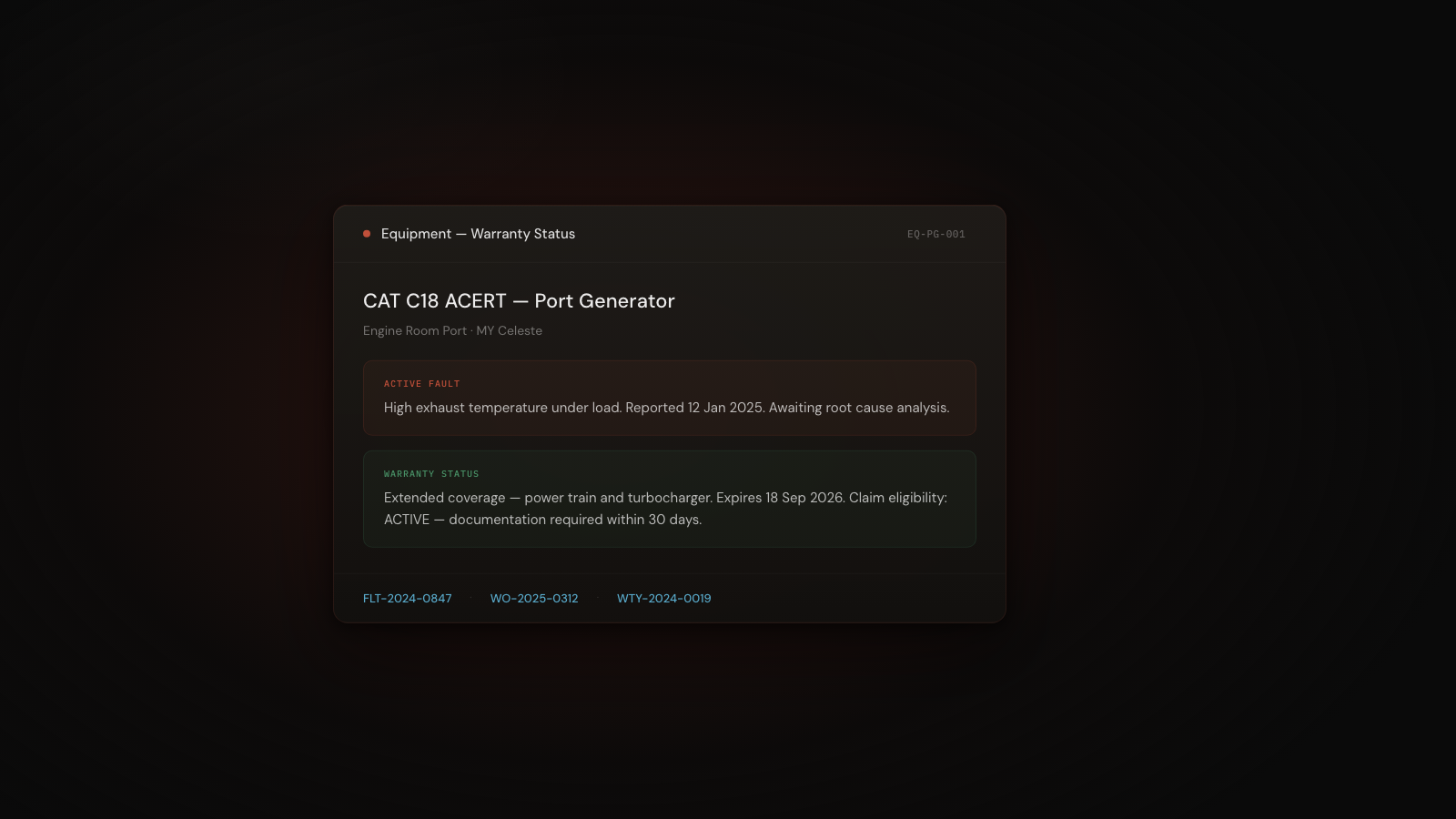
The fault-to-warranty chain in a connected system: fault diagnosis, corrective action, parts used, and warranty status linked in a single traceable record that survives crew rotation.
What marine equipment manufacturers actually require
The specific requirements vary by manufacturer, but the pattern is consistent. Consider MAN marine engines, which power a significant proportion of the superyacht fleet. MAN's warranty compliance requires that every service is performed by an authorised workshop, that the maintenance record is stamped and signed for each service, that all entries are legible and complete, and that original manufacturer parts are used throughout [4].
This is not unique to MAN. Caterpillar, MTU, Volvo Penta, and other marine engine manufacturers impose similar conditions. The warranty is not a guarantee against failure. It is a conditional agreement that assumes documented, compliant maintenance has been performed throughout the warranty period.
The challenge for vessel operators is that the engineer who performed the maintenance may no longer be aboard when the claim is filed. Rotational contracts, crew changes, and the natural cycle of career movement in the superyacht industry mean that the person with direct knowledge of the maintenance history is often unavailable. If the records they maintained are incomplete, scattered across personal files, or locked in a system that the incoming engineer cannot effectively search, the warranty claim rests on documentation that no one present can fully explain.
Why maintenance records alone are not enough for warranty claims
Most planned maintenance systems record that a task was completed. They do not record the context that connects that task to a warranty obligation.
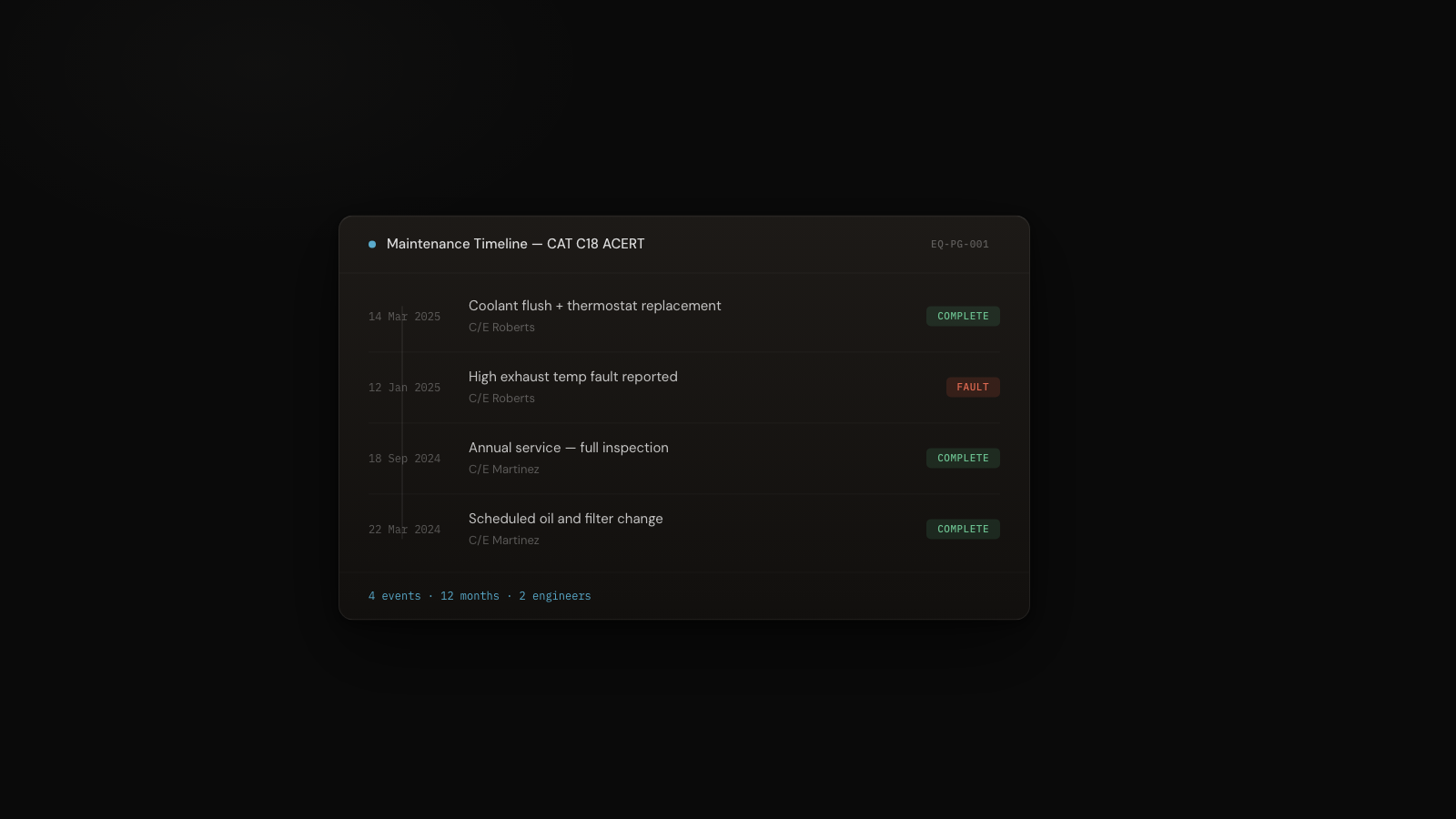
A maintenance log shows that the starboard engine was serviced on a given date. It does not show that the service was performed within the manufacturer's required interval, using approved parts, by an authorised technician, and that the fault which later occurred was unrelated to the work performed. Each of these connections requires cross-referencing different data sources: the equipment record, the parts inventory, the warranty terms, the fault diagnosis, and the service history.
When these data sources exist in separate systems — or in separate folders, spreadsheets, and email threads — the burden of assembling a coherent warranty claim narrative falls on the engineer. Under time pressure, with potentially incomplete access to records created by a predecessor, that assembly process often produces exactly the kind of documentation gaps that manufacturers use to deny claims.
Maritime insurers compound the problem. Classification status and maintenance history materially influence coverage terms, premium structure, and claims assessment [6]. A vessel that cannot produce connected maintenance records during a claim investigation signals operational risk to the underwriter — regardless of whether the maintenance was actually performed.
What defensible warranty documentation looks like
Documentation that survives a warranty claim investigation has five characteristics.
It is timestamped — not "March 2026" but "15 March 2026, 07:42, logged by Chief Engineer M. Torres." The specificity matters because manufacturers compare service dates against warranty intervals measured in hours, days, and operational cycles.
It is attributable — every action is tied to a named, qualified individual. Anonymous log entries do not satisfy OEM requirements for authorised service partner documentation.
It is linked across domains — the fault diagnosis connects to the work order, the work order connects to the parts used, the parts connect to the equipment record, and the equipment record connects to the warranty period. The chain is traceable from failure to resolution without gaps. This is the evidence chain that manufacturers require.
It is immutable — once a record is created, it cannot be altered without a visible audit trail. Manufacturers and insurers need assurance that records were created contemporaneously with the work, not reconstructed after the fact to support a claim.
It is searchable — when a claim requires the full service history of a specific piece of equipment, that history must be retrievable without manually searching through folders, spreadsheets, and email archives. The engineer filing the claim may not be the engineer who performed the maintenance. The system must make the records findable regardless of who is searching. When every record is linked to the vessel's cross-domain knowledge base and preserved across handovers, the vessel itself becomes the documentation authority — not any individual crew member.
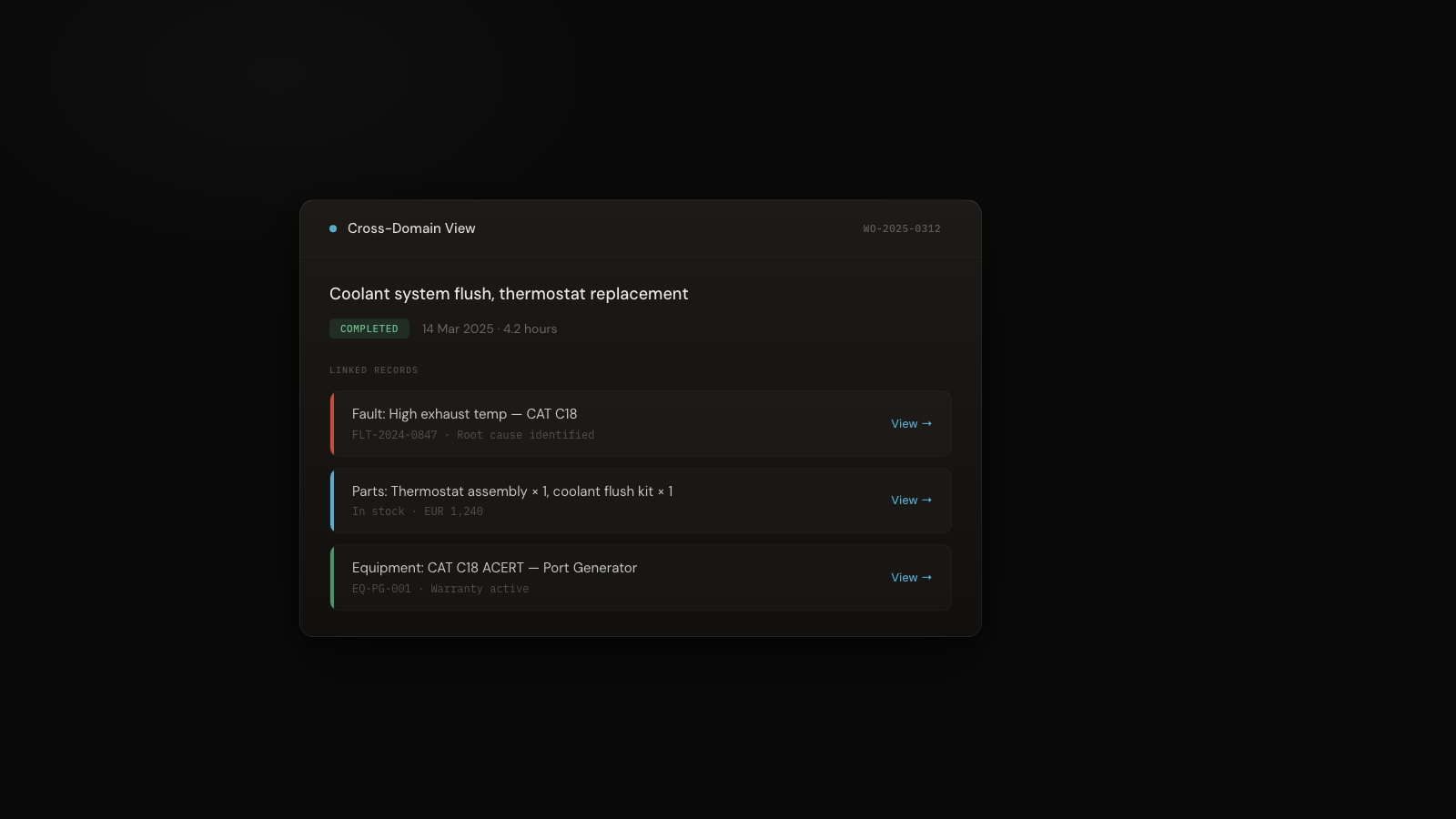
Cross-domain warranty documentation — fault, work order, parts, equipment record, and warranty period linked in one traceable chain that any engineer can search regardless of when they came aboard.
Summary
- A single denied warranty claim on marine equipment costs EUR 20,000 to EUR 100,000 — and the burden of proof lies with the vessel owner, not the manufacturer.
- Five documentation failures account for most denials: missing logs, unauthorised repairs, late notification, no photographic evidence, and no linked history connecting the failure to its maintenance context.
- OEM warranty compliance requires stamped, signed, dated records from authorised service partners using approved parts — conditions that must be met throughout the warranty period, regardless of crew changes.
- Maintenance records stored in separate, unconnected systems force engineers to manually reconstruct claim narratives — producing the documentation gaps that manufacturers interpret as negligence.
- Defensible warranty documentation is timestamped, attributable, cross-domain linked, immutable, and searchable — characteristics that require the documentation system to be designed for warranty defensibility, not retrofitted after a claim is filed.
CelesteOS is a Maritime Technical Intelligence System for superyachts that creates timestamped, immutable, cross-domain linked records across maintenance, faults, parts, and compliance. Learn more at celeste7.ai.
[1] Brookes Bell, "Warranty and paint claims lead the way for superyacht cases" — brookesbell.com
[2] YATCO, "Boat Warranty & Yacht Guarantees: What's Covered, Costs & Claim Process" — yatco.com
[3] Claimar, "Technical Errors That Invalidate Yacht Insurance Claims" — claimar.com
[4] Quality Yachting, "Protecting Your Investment: A Guide to MAN Engine Warranty Compliance" — qualityyachting.com
[5] DiscoverBoating, "The Top Boat Warranty Basics Every Owner Should Understand" — discoverboating.com
[6] Markel, "Yacht Insurance" — markel.com