The handover that should exist but rarely does
The engineering handover is the most important knowledge transfer event on a superyacht. It is also the most inconsistent. Industry data shows that 66% of handovers last one week or less, with the outgoing engineer frequently departing before the overlap period concludes [1]. What transfers in that window is mechanical: where the tools are, how to start the generators, which valves are normally open.
What does not transfer is context. The operational intelligence that took months to accumulate — fault patterns, supplier reliability, equipment-specific workarounds, compliance timelines — disappears because no system compiles it automatically. The departing engineer would need to reconstruct it from scattered records across multiple modules, spreadsheets, and email archives. Under time pressure, at the end of a rotation, with the relief engineer already aboard, that reconstruction rarely happens.
The result is a handover that is either verbal, incomplete, or absent entirely.
What the handover contains
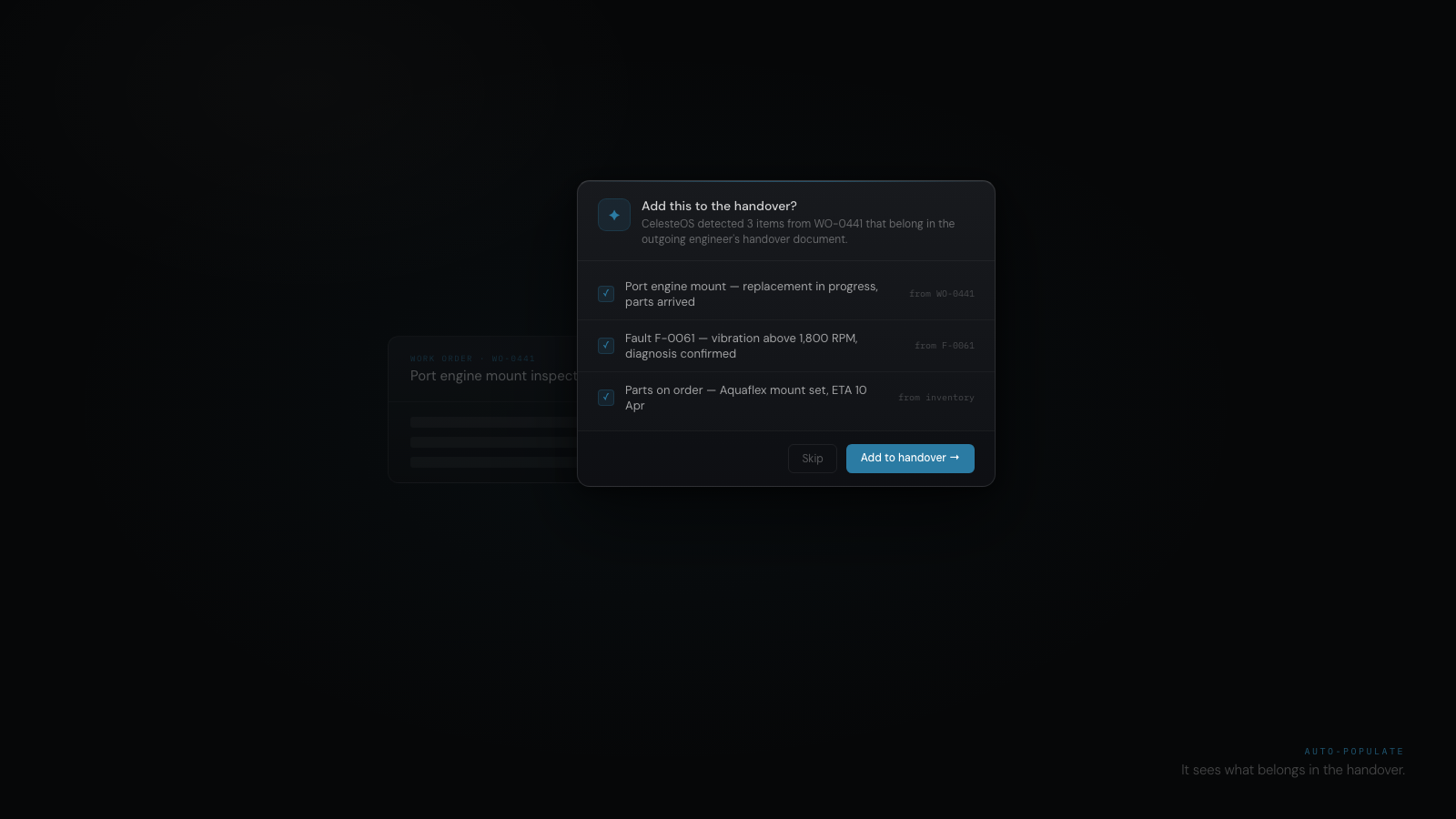
A handover document generated from connected vessel data does not depend on the departing engineer's diligence, memory, or available time. It is compiled automatically from every operational domain the system tracks.
The Technical Handover Report for M/Y Celeste — a real document generated by CelesteOS — contains 24 items across five departments: Deck, Command, Engineering, Interior, and Admin Compliance. Four items are flagged as critical. The document is structured as follows.
Cover page and summaryThe document opens with a KPI grid: total items, critical items requiring immediate attention, and the handover period. A one-sentence narrative summarises the scope: "This handover covers 24 items across 5 departments. 4 items require critical attention." The incoming engineer knows, before reading a single detail, the scale and urgency of what they are inheriting.
Table of contents by departmentEach department — Deck (4 items), Command (6 items), Engineering (7 items), Interior (1 item), Admin Compliance (6 items) — is listed with item counts. The structure mirrors how a vessel actually operates: by department, not by software module.
Item-level detail with linked recordsEach handover item contains three elements that distinguish a system-generated handover from a manual one.
First, a narrative summary written in operational language. Not a database field dump — a description that tells the incoming engineer what happened, what was done, and what remains. For example: "The removal of main engine fuel injector #3 is complete. A new injector has been fitted and torqued to specification. The fuel lines have been reconnected and pressure tested. A sea trial is scheduled for 26 March to verify combustion balance."
Second, a direct hyperlink to the source record in CelesteOS. "View Work Order" links to the exact work order. "View Fault" links to the fault record with full diagnosis history. "View Equipment" links to the equipment record with maintenance timeline. The handover is not a static PDF — it is a live index into the vessel's operational data. The incoming engineer can follow any item to its complete context with one click.
Third, prioritised actions. Each item lists what the incoming engineer needs to do, tagged by priority. "[HIGH] Verify combustion balance during the sea trial. [NORMAL] Check exhaust temperatures across all 6 cylinders post-trial." The actions are specific, sequenced, and attributable.
How it assembles itself
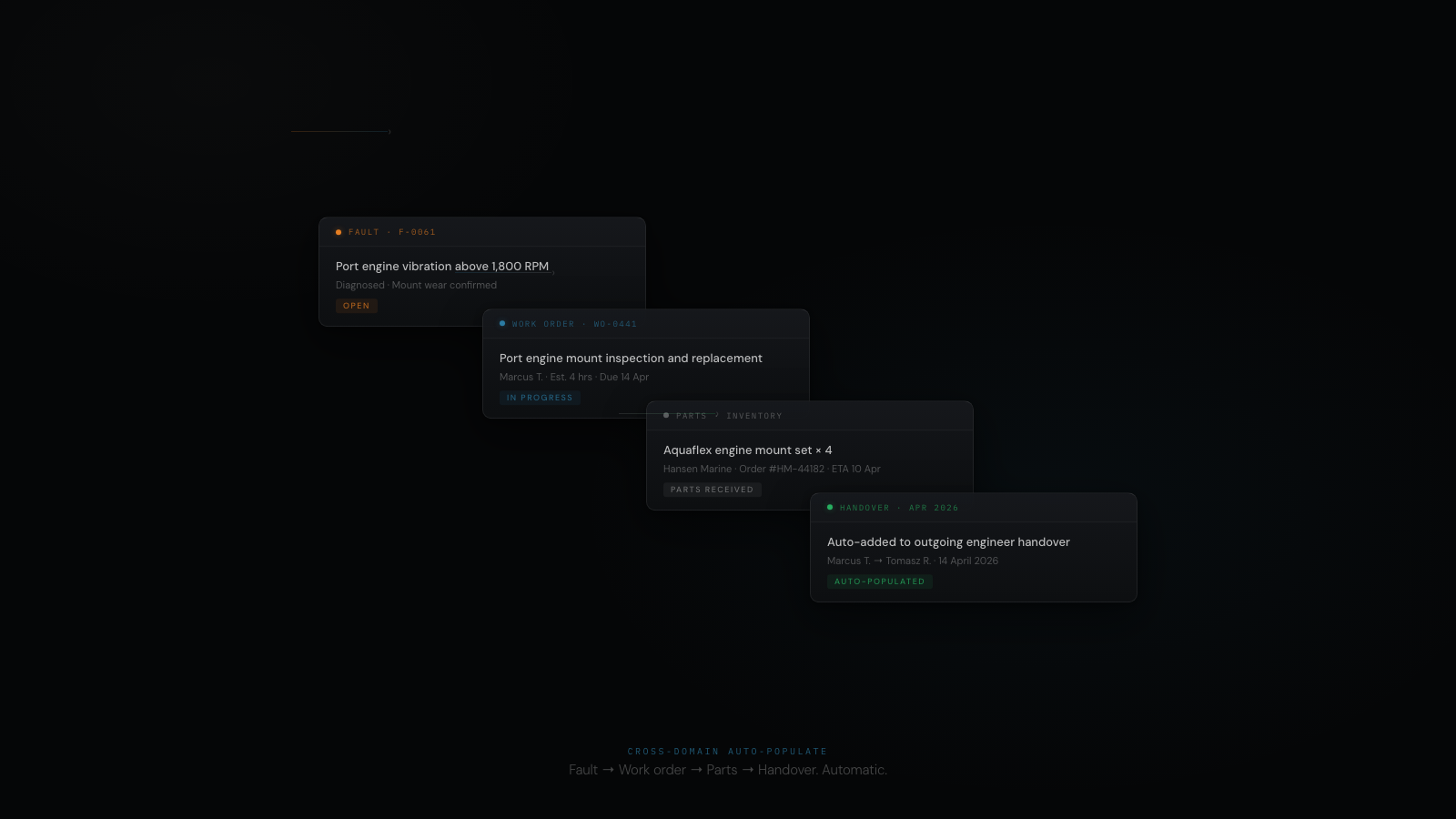
A conventional handover document — whether a Word file, a spreadsheet, or a verbal walkthrough — describes problems in isolation. "The hydraulic passerelle has been slow to deploy." The incoming engineer reads this and has questions. When did it start? What has been tried? Is a technician booked? Is the part under warranty? What does the manufacturer say?
In a manual handover, answering those questions requires the incoming engineer to search through the maintenance system, check the fault log, review the parts inventory, and look through email correspondence. Each answer lives in a different system.
In a system-generated handover, the item includes a direct link to the fault record. The fault record links to the equipment. The equipment links to the warranty status. The work order links to the parts used. The incoming engineer follows one link and reaches the complete operational context — without searching, without cross-referencing, without asking the departing engineer to explain.
The handover item for the passerelle reads: "The hydraulic passerelle has exhibited a slow deployment speed during the last three port calls. The hydraulic fluid level was checked and topped up. It is suspected that the flow control valve may require adjustment or replacement. A shore-side hydraulic engineer has been booked for inspection during the next yard visit scheduled for Palma on 2 April." Below the summary: "View Fault" — one click to the full diagnosis history, related work orders, and supplier correspondence.
Signed and immutable
The document closes with an authorisation section: Prepared By (the departing officer) and Reviewed By (the head of department). Once signed, the handover is immutable — a permanent record of what was communicated, by whom, and when.
With a manual handover, the incoming engineer inherits equipment and a verbal briefing. Within days, the briefing fades. Within weeks, operational context that was communicated verbally is lost. The incoming engineer operates the vessel based on what the maintenance system shows — which is a record of tasks completed, not a map of what matters.
With a system-generated handover, the incoming engineer inherits a structured index into every active operational thread on the vessel. Outstanding faults with full diagnosis history. Pending work orders with parts status. Certificates approaching expiry with compliance deadlines. Supplier contacts with correspondence history. Operational notes that would otherwise exist only in the departing engineer's memory.
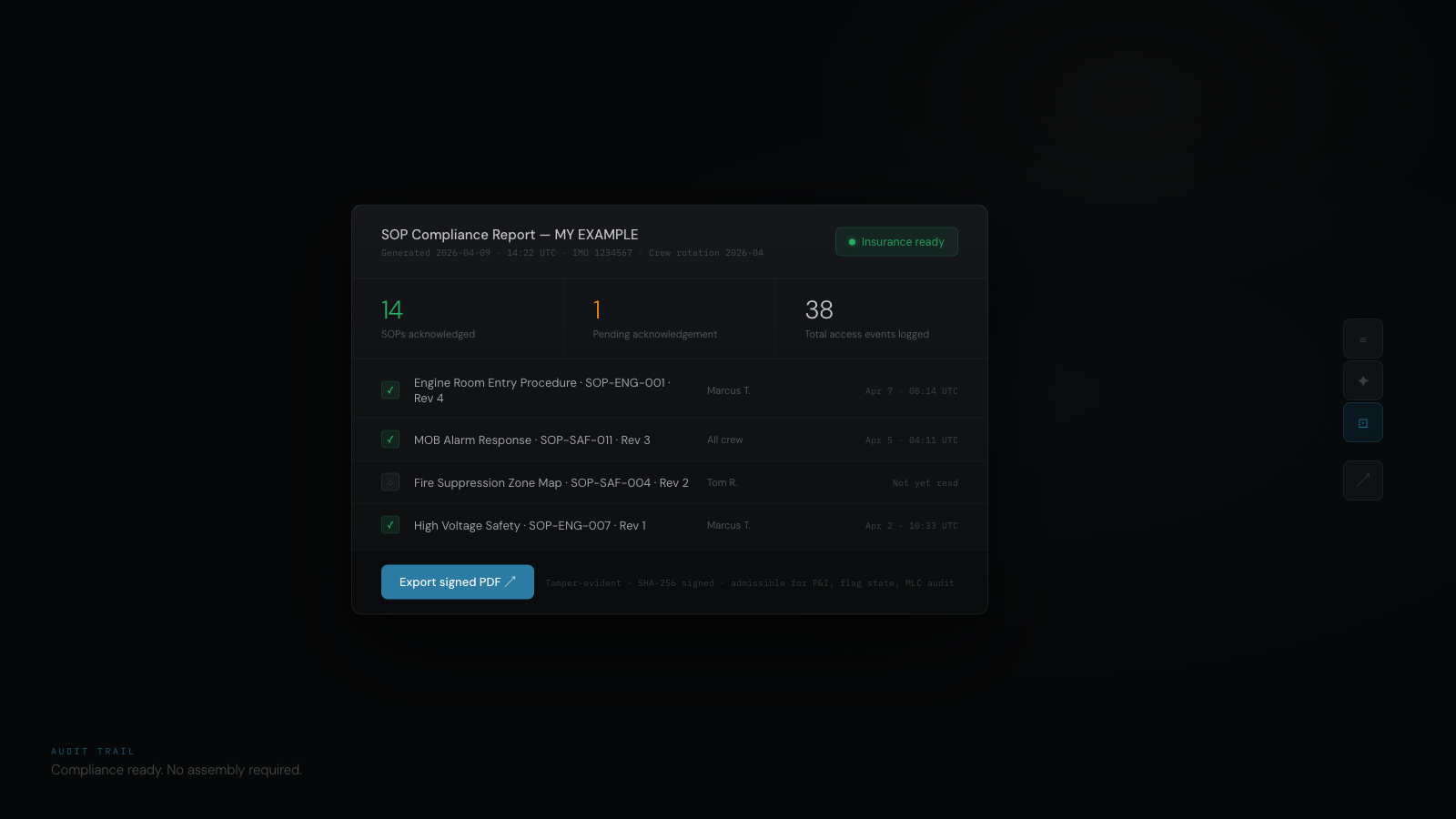
The handover does not replace the walkthrough. The departing engineer still shows the incoming engineer the vessel, discusses priorities, answers questions. But the system-generated document ensures that nothing is omitted because it was forgotten, rushed, or deliberately minimised. The document is a product of the vessel's data, not of the departing engineer's effort.
Summary
- Most engineering handovers on superyachts are verbal, incomplete, or absent — assembled manually under time pressure from scattered records across disconnected systems.
- A system-generated handover compiles items automatically from every operational domain: faults, work orders, parts, certificates, equipment status, and operational notes.
- Each handover item contains a narrative summary, a direct hyperlink to the source record in the system, and prioritised actions for the incoming engineer.
- Auto-linking to source records means the incoming engineer can follow any handover item to its complete operational context with one click — no searching, no cross-referencing, no reliance on verbal explanation.
- The handover becomes a product of how the vessel is managed, not an additional administrative task performed under time pressure during crew rotation.
CelesteOS is a Maritime Technical Intelligence System for superyachts that auto-generates structured handover documents from connected vessel data — linking every item to its source record across faults, work orders, parts, certificates, and operational notes. Learn more at celeste7.ai.
[1] Seahub, "Superyacht Engineering Handover: Good, Bad or Essential?" — seahubsoftware.com