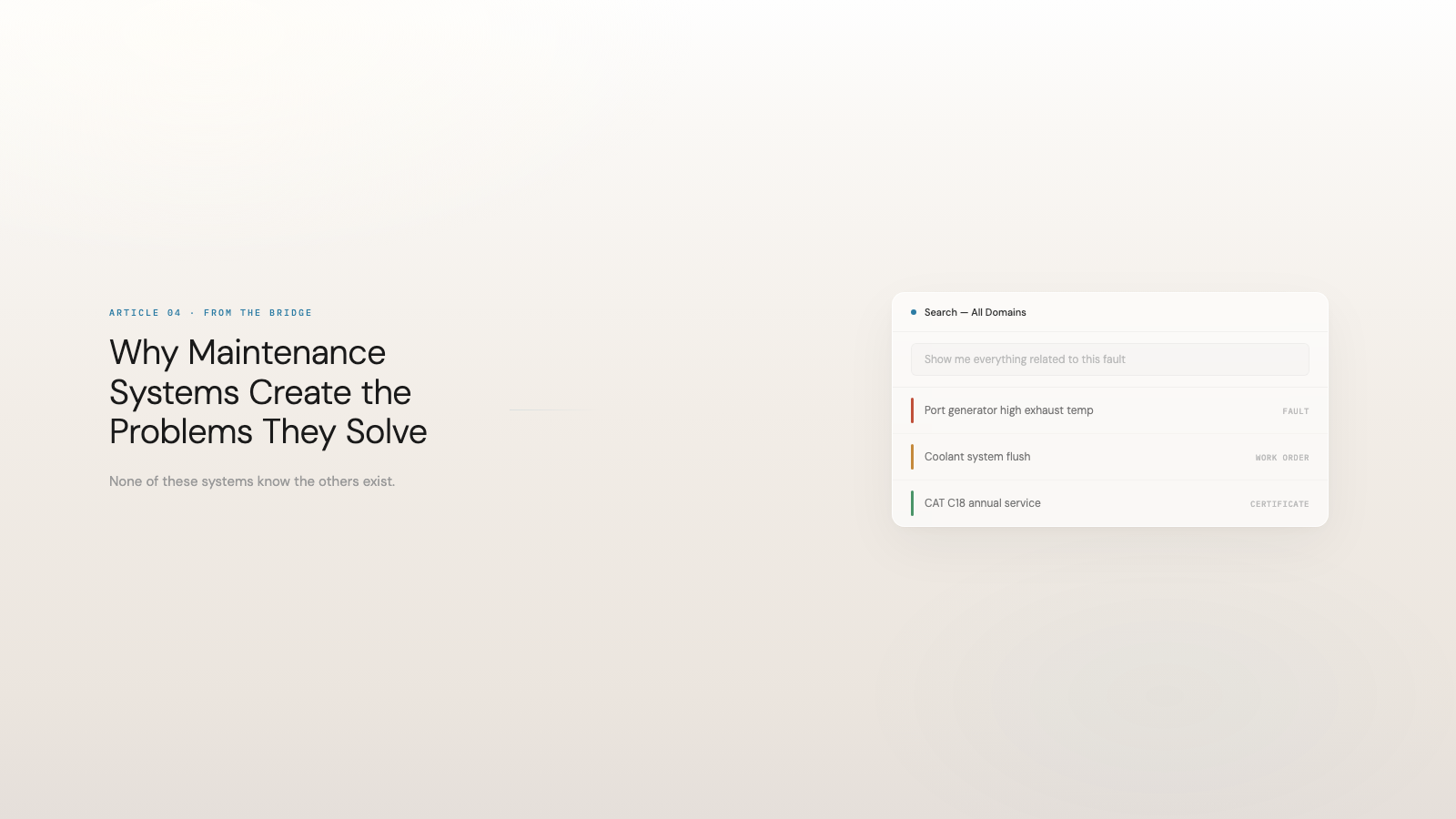
The daily reality of siloed yacht maintenance
On a typical 40-metre motor yacht, operational data lives in at least four places. The planned maintenance system — if one exists — records work orders and task completions. The parts inventory sits in a separate spreadsheet or a different module that may or may not sync with the maintenance schedule. Certificate expiry dates live in a folder, sometimes digital, sometimes physical. And critical supplier correspondence — warranty terms, delivery confirmations, technical advisories — sits in email inboxes that belong to individual crew members.
A significant proportion of vessels in the 30 to 50 metre range still operate on a combination of spreadsheets and paper-based records [1]. Even vessels that have adopted a planned maintenance system often find that the system records tasks but does not connect them to the broader operational context. Technical documentation is frequently incomplete, outdated, or stored in formats that only the person who created them can navigate [2].
The result is that the chief engineer becomes the integration layer. They are the person who knows that the work order on the port generator relates to a fault diagnosed three months ago, that the parts for the repair were ordered from a specific supplier, that the warranty on the generator expires in four months, and that the budget for engine maintenance is nearly exhausted for the quarter. None of this information exists in a single system. It exists in the engineer's head.
Five data silos that cost superyachts money
The separation between maintenance domains is not an inconvenience. It is a structural failure with specific, measurable consequences.
Work orders do not know about parts inventoryAn engineer creates a work order for a pump rebuild. The parts needed are in the store — but the work order system does not check stock levels. The engineer orders replacements that are already aboard, or discovers mid-repair that a critical gasket is out of stock. Disconnected systems and manual reconciliation translate directly to duplicated orders, delayed repairs, and wasted labour [3].
Fault records do not link to warranty periodsA component fails within its warranty period. The engineer files a claim. The manufacturer requests the full maintenance history, the fault diagnosis, the parts used in previous repairs, and evidence that all service was performed by authorised technicians. Each of these records exists in a different system. The engineer spends hours assembling a narrative from scattered sources — and the gaps in that narrative are interpreted as gaps in maintenance practice.
The maintenance schedule does not know about the budgetA planned maintenance task is due. The parts cost EUR 4,000. The quarterly maintenance budget has EUR 1,200 remaining. The engineer does not discover this until the purchase order is rejected. The task is deferred — but the deferral is not recorded against the equipment's maintenance history, so the next engineer sees an overdue task with no explanation.
Emails with supplier context live outside the maintenance systemThe previous engineer negotiated a bulk pricing agreement with a chandlery. The delivery terms, payment conditions, and technical specifications were confirmed by email. When the engineer rotates off, those emails leave with their account. The incoming engineer starts the supplier relationship from scratch.
The crew handover cannot pull from any of these systemsWhen a chief engineer rotates off, the handover document — if one exists — is assembled manually from memory and personal notes. The maintenance system contributes a task list. Everything else — fault context, supplier intelligence, budget status, operational notes — must be reconstructed by the departing engineer in the final days of their rotation, under time pressure, from information scattered across systems that were never designed to be read together.
Why every maintenance problem on a superyacht traces back to disconnected systems
The knowledge crisis described in the context of crew rotation is not caused by negligent engineers. It is caused by systems that store information in silos. When the engineer is the only connection between those silos, the knowledge is tied to the person, not to the vessel. When the person leaves, the connections break.
Denied warranty claims are not caused by poor maintenance. They are caused by documentation that exists in fragments across disconnected systems, making it impossible to present a complete, verifiable chain of evidence. The maintenance was performed. The records were created. But the records do not link to each other in a way that satisfies a manufacturer's claims investigation.
Handover failures are not caused by careless departing engineers. They are caused by the absence of a system that can automatically compile equipment status, outstanding defects, parts on order, certificate expiry dates, and operational context into a single document. The handover fails because the systems were never designed to produce one.
Each of these problems is treated as an independent challenge. In practice, they are all symptoms of the same structural cause: maintenance data that exists in silos cannot serve the operational needs of a vessel where every domain — faults, work orders, parts, certificates, budgets, suppliers, compliance — depends on the others.
Why "integrated" is not the same as cross-domain
Every yacht maintenance system on the market describes itself as integrated. The word has become a positioning claim, not a technical description.
Integration, in practice, means that the maintenance module and the parts module exist within the same software platform. The engineer can switch between them without logging into a different system. This is a real improvement over spreadsheets. It is not a solution to the silo problem.
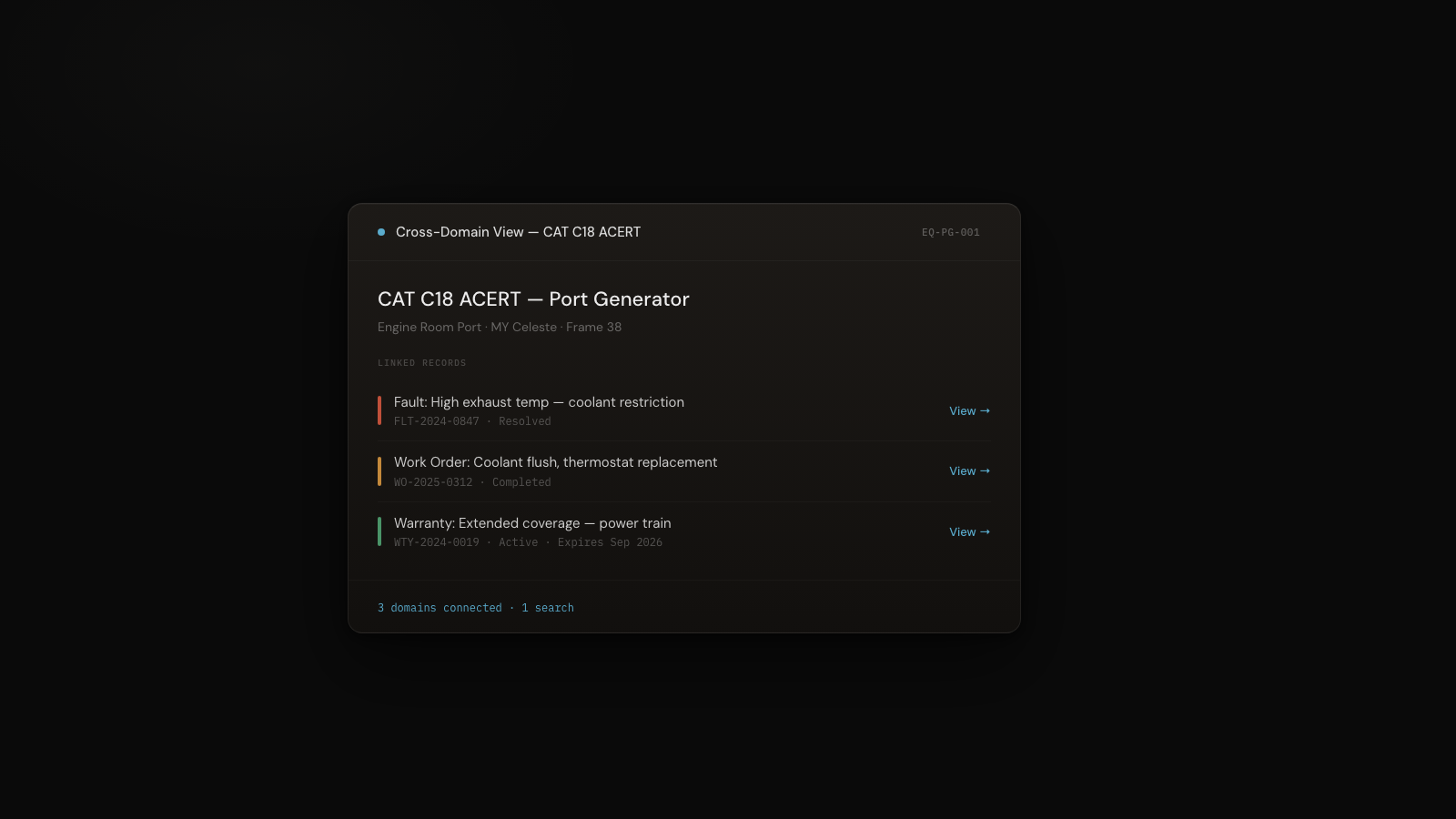
Cross-domain means something different. It means that when an engineer opens a fault record, the system surfaces the equipment's warranty status, the parts that have been used in previous repairs of the same fault, the work orders that were generated, and the supplier correspondence related to the equipment — without the engineer searching for each piece separately. The fault record does not exist in isolation. It exists in context.
The distinction matters because integration solves a workflow problem — fewer logins, fewer tabs. Cross-domain solves a knowledge problem — the information that an engineer needs to make a decision is assembled by the system, not by the engineer's memory.
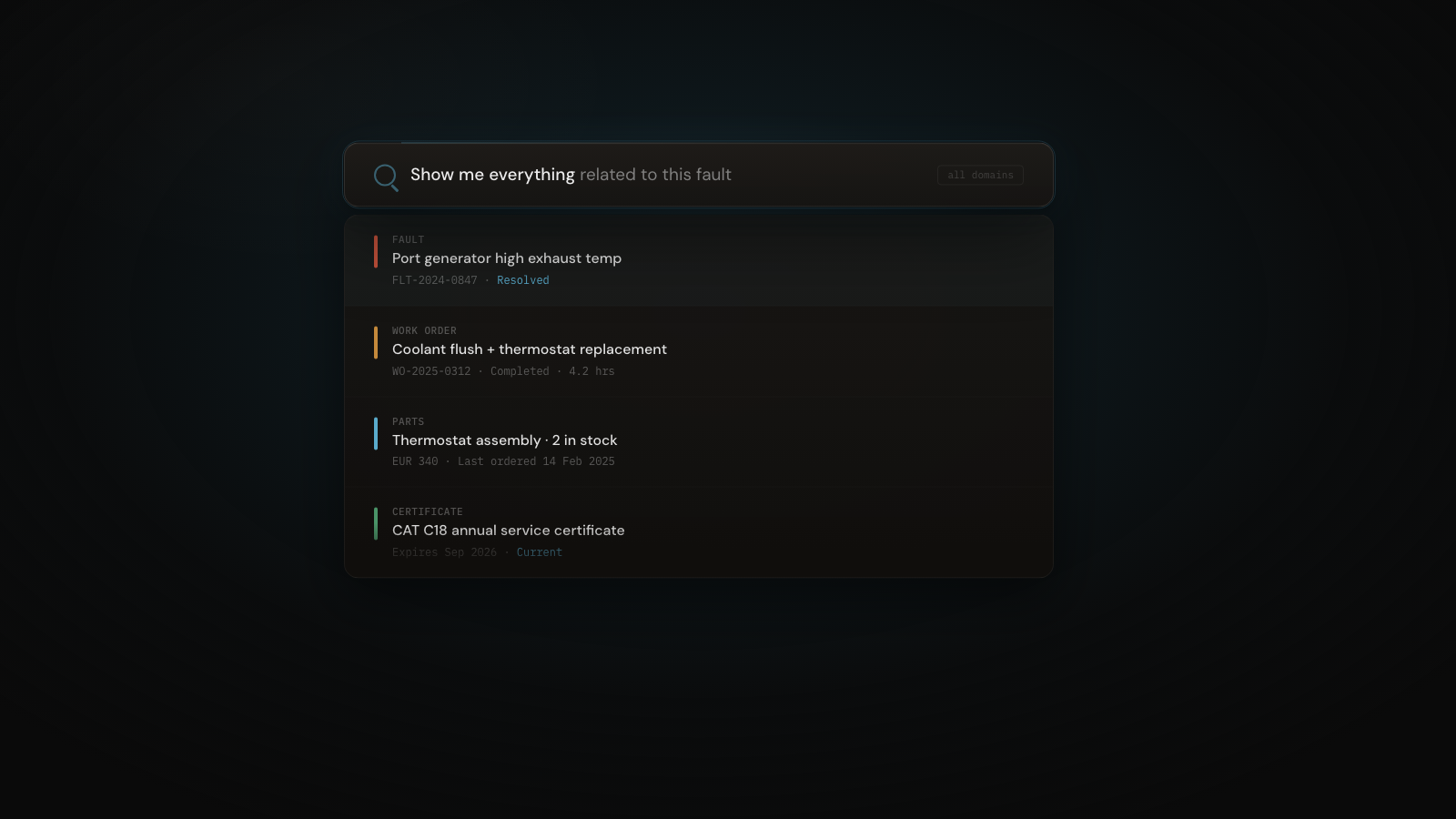
A single search returning results across every operational domain — faults, work orders, parts, certificates, and supplier correspondence. This is what cross-domain search looks like when the system connects records rather than storing them in parallel modules.
The test for any yacht maintenance system
There is a single question that reveals whether a maintenance system is genuinely connected or superficially integrated.
Can it answer: "Show me everything related to this fault"?
Not "show me the fault record." Everything. The equipment it affects. The warranty status of that equipment. The last three work orders on it. The parts used. The parts currently in stock. The supplier who provided them. The certificate that depends on the equipment being operational. The email thread where the manufacturer confirmed the repair procedure.
If answering that question requires the engineer to open four modules, cross-reference two spreadsheets, and search their email inbox, the system is siloed — regardless of what its marketing materials claim.
The value of maintenance data on a superyacht is not in the records themselves. It is in the connections between them. A work order that links to a fault that links to a part that links to a warranty that links to a supplier creates operational intelligence. A work order that exists alone in a task list is a checkbox. Seven specific connections determine whether a system produces that intelligence or stores isolated records.
Summary
- Superyacht maintenance data typically lives in four or more disconnected systems — PMS, parts inventory, certificate tracking, and email — with the chief engineer serving as the only integration layer between them.
- Five specific silos — work orders, fault records, budget, supplier correspondence, and handover documentation — create measurable financial consequences including duplicated orders, denied warranty claims, and repeated fault diagnoses.
- Knowledge loss at crew change, handover failures, and warranty documentation gaps are symptoms of the same structural problem: disconnected systems that tie operational knowledge to individuals rather than to the vessel.
- The distinction between "integrated" and "cross-domain" is the difference between features that coexist and features that inform each other — a difference that determines whether the system creates operational intelligence or stores isolated records.
- The test is simple: can the system answer "show me everything related to this fault" in one search? If not, the system is siloed regardless of its marketing.
CelesteOS is a Maritime Technical Intelligence System for superyachts where every record — faults, work orders, parts, certificates, budgets, and supplier correspondence — is connected across domains and searchable in a single query. Learn more at celeste7.ai.
[1] Superyacht Data, "PMS Set Up" — superyacht-data.com
[2] Superyacht Content, "Seahub Blog: Planned Maintenance Systems, 5 Things To Know" — superyachtcontent.com
[3] Orderry, "Marine Repair Software" — orderry.com