The navigation problem that kills adoption
Article #7 in this series examined why yacht crews bypass their maintenance software. The deepest reason — beneath the friction, the duplicate entry, and the training overhead — is the navigation model itself.
Conventional planned maintenance systems are built around modules. A maintenance module. A parts module. A documents module. A defect log. Each module has its own navigation tree, its own filters, its own search scope. To find information, the engineer must first know which module contains it, then navigate to the right section within that module, then apply the correct filters to surface the right record.
This model assumes the engineer knows where the information lives before they search for it. At 11pm, on a vessel they boarded hours ago, that assumption fails. The engineer does not know the module structure. They do not know the filter taxonomy. They know what they are looking for — "port generator overheating" — and they need an answer.
Every step between the question and the answer is friction. Every click is a reason to pick up the phone instead.
What search-first means on a vessel
Natural language search means the engineer types what they are thinking, in the language they naturally use, and the system returns results from every domain.
In CelesteOS, typing "oil filter main engine" returns results grouped by domain: faults related to oil and the main engine, inventory items matching the query, and documents containing relevant procedures. The system parses the query into understood terms — "oil filter", "main engine", "location" — and searches across faults, work orders, inventory, certificates, documents, and equipment records simultaneously.
The engineer does not select a module. They do not apply a filter. They do not need to know that oil filters are tracked in the inventory module while oil leaks are tracked in the fault module while oil change procedures are in the documents module. The search crosses every boundary.
This is not a convenience feature. It is an architectural decision. Search is the interface — not a feature within the interface.
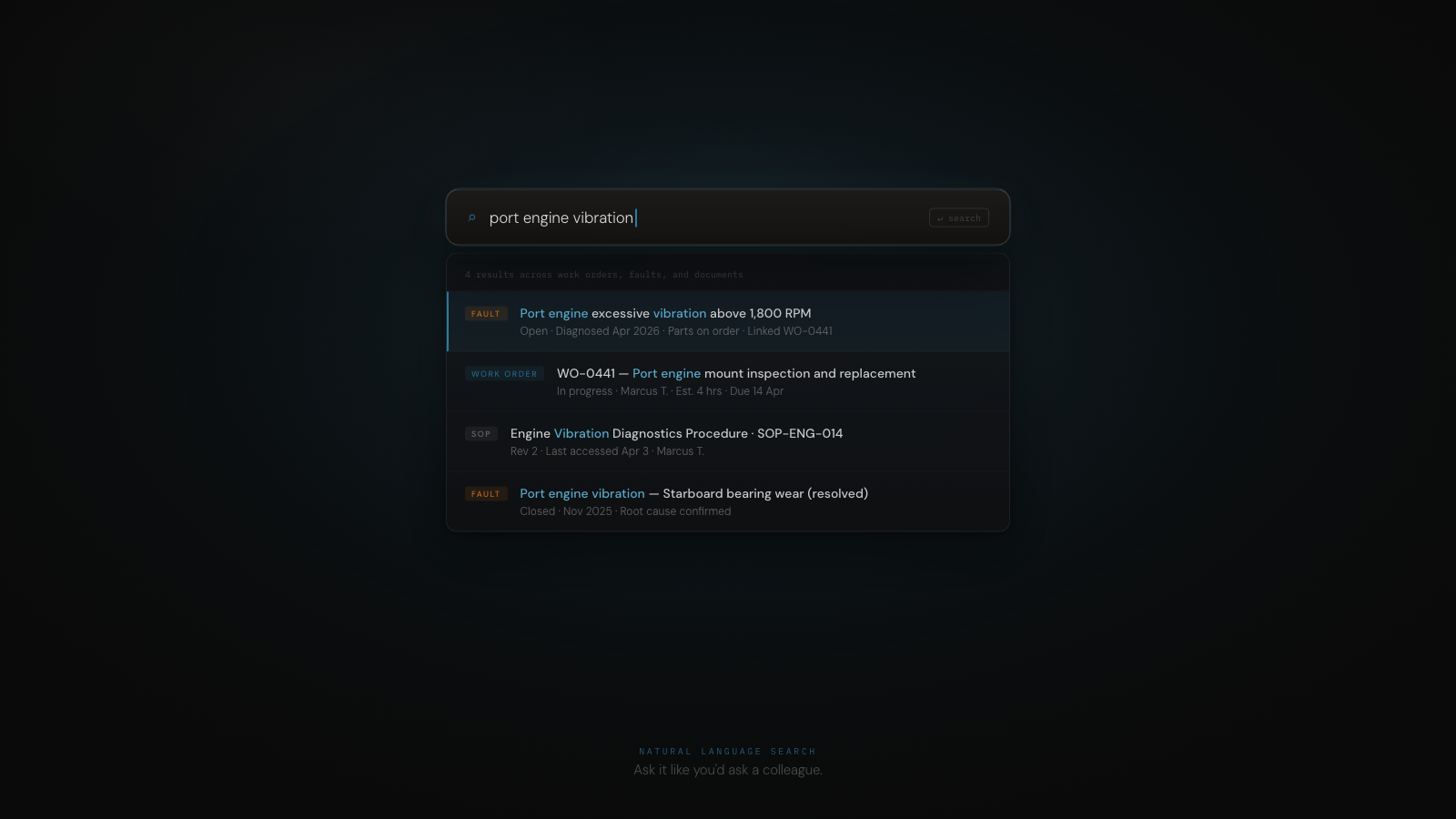
What the system returns from a single query
A single search for "oil" in CelesteOS returns:
Faults"Engine Room — Oil Leak" (critical, 2 days open, linked to work order WO-1234). "Stabiliser Port — Oil Contamination" (high priority, 1 day open, linked to WO-1156). Each fault shows its severity, age, and connected work order — without the engineer opening a separate module.
Inventory"Oil Filter 5W-40" (2 remaining of 10, critical stock). "Hydraulic Oil — ISO 46" (8 remaining, status OK). Stock levels visible immediately alongside the faults that may require these parts.
Documents"Engine Oil Change Procedure" (machinery manual, page 42). The relevant SOP surfaces alongside the faults and parts — not locked in a separate documents module that requires its own navigation.
Five results. Three domains. One query. The engineer sees the fault, the parts available to fix it, and the procedure to follow — in a single view, within seconds of typing.
Zero training
Conventional PMS adoption fails because the software requires learning. One chief engineer reported budgeting two full days of every crew rotation exclusively for PMS training [1]. Two days where a qualified engineer learns to navigate menus instead of maintaining the vessel.
Natural language search eliminates the navigation layer entirely. There is nothing to learn. The engineer types what they need — in whatever language they use naturally — and the system responds. "Vibration port engine" works. "Watermaker membrane" works. "Certificate expiring" works. The system does not require the engineer to use the correct module name, the correct filter category, or the correct field label. It understands operational language because it was built to parse it.
This changes the adoption equation. A system that requires zero training is a system that works on the first day of a rotation. A system that works on the first day is a system the engineer reaches for at 2am. A system the engineer reaches for at 2am is a system that captures records — because using it is faster than the alternative.
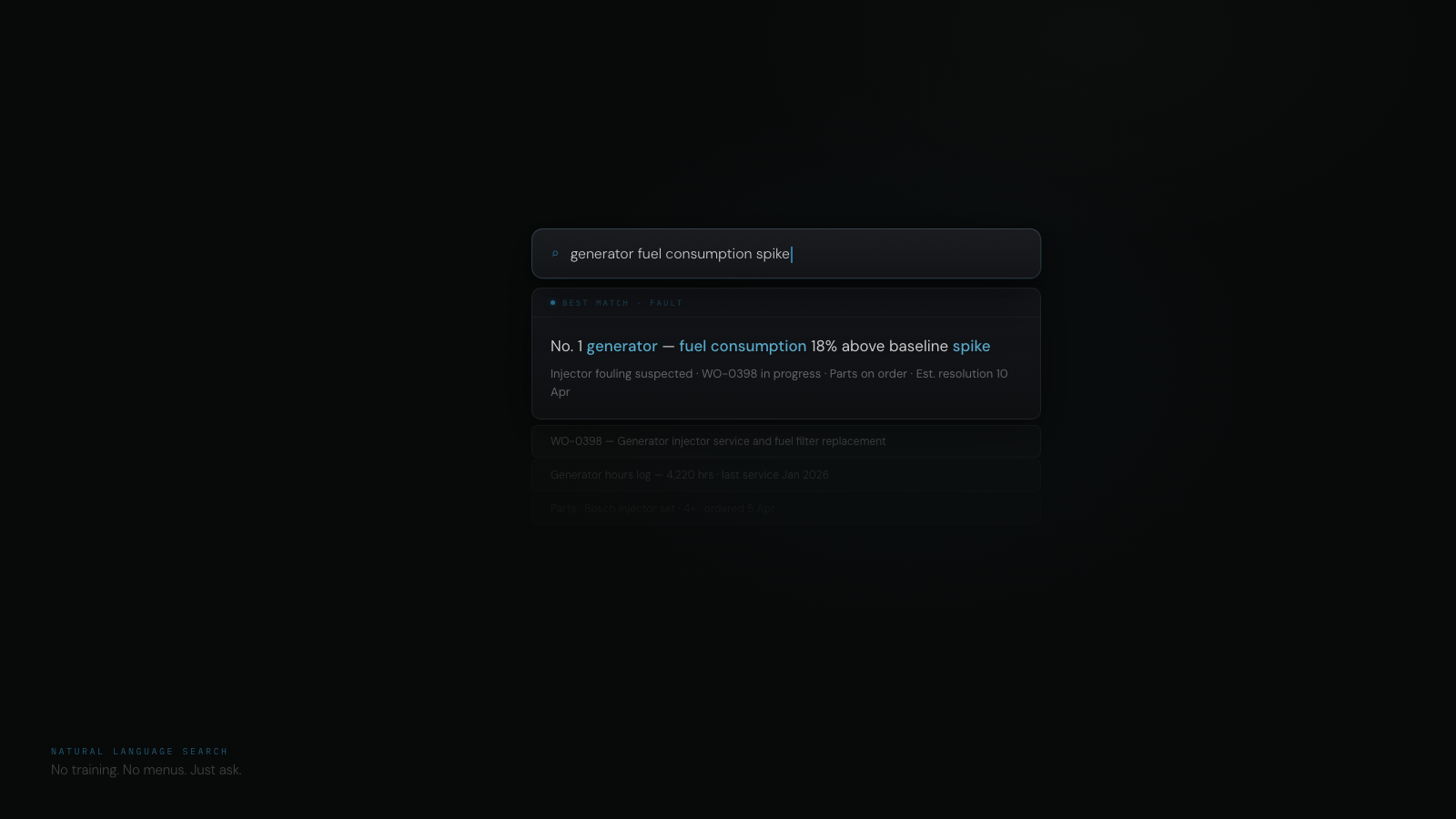
What the idle state shows without being asked
When the engineer is not searching, CelesteOS does not show a dashboard. It shows a prioritised list of what needs attention right now.
Outstanding faults with severity and age. Overdue maintenance tasks. Certificates approaching expiry. Parts below minimum stock with reorder status. Incoming shipments with expected delivery times. Work orders pending sign-off.
This is not a dashboard — dashboards require interpretation. This is a priority surface — it shows the engineer what to deal with first, ordered by urgency, updated in real time. The engineer does not navigate to find problems. The problems surface themselves.
When the engineer sees something that needs investigation, they type a query. When they need to act, they click the item. The entire interaction model is: see what matters, search for context, act on evidence. No modules. No menus. No learning curve.
Summary
- Conventional yacht maintenance systems require engineers to navigate modules, apply filters, and learn software structure before finding information. This navigation friction is the deepest cause of PMS adoption failure.
- Natural language search eliminates the navigation layer. The engineer types what they are thinking — in operational language — and the system returns results from every domain: faults, work orders, inventory, documents, certificates, and equipment.
- A single query surfaces connected results across domains: the fault, the parts to fix it, and the procedure to follow — in one view, within seconds.
- Zero training means the system works on the first day of a crew rotation. A chief engineer joining a vessel at 11pm types what they need and the system answers.
- The idle state surfaces priorities without being asked — outstanding faults, overdue tasks, expiring certificates, low stock — eliminating the need to navigate to find problems.
CelesteOS is a Maritime Technical Intelligence System for superyachts where search is the interface — one query returns results across every operational domain, and the system surfaces what matters before the engineer asks. Learn more at celeste7.ai.
[1] Superyacht Content, "Seahub Blog: Planned Maintenance Systems, 5 Things To Know" — superyachtcontent.com