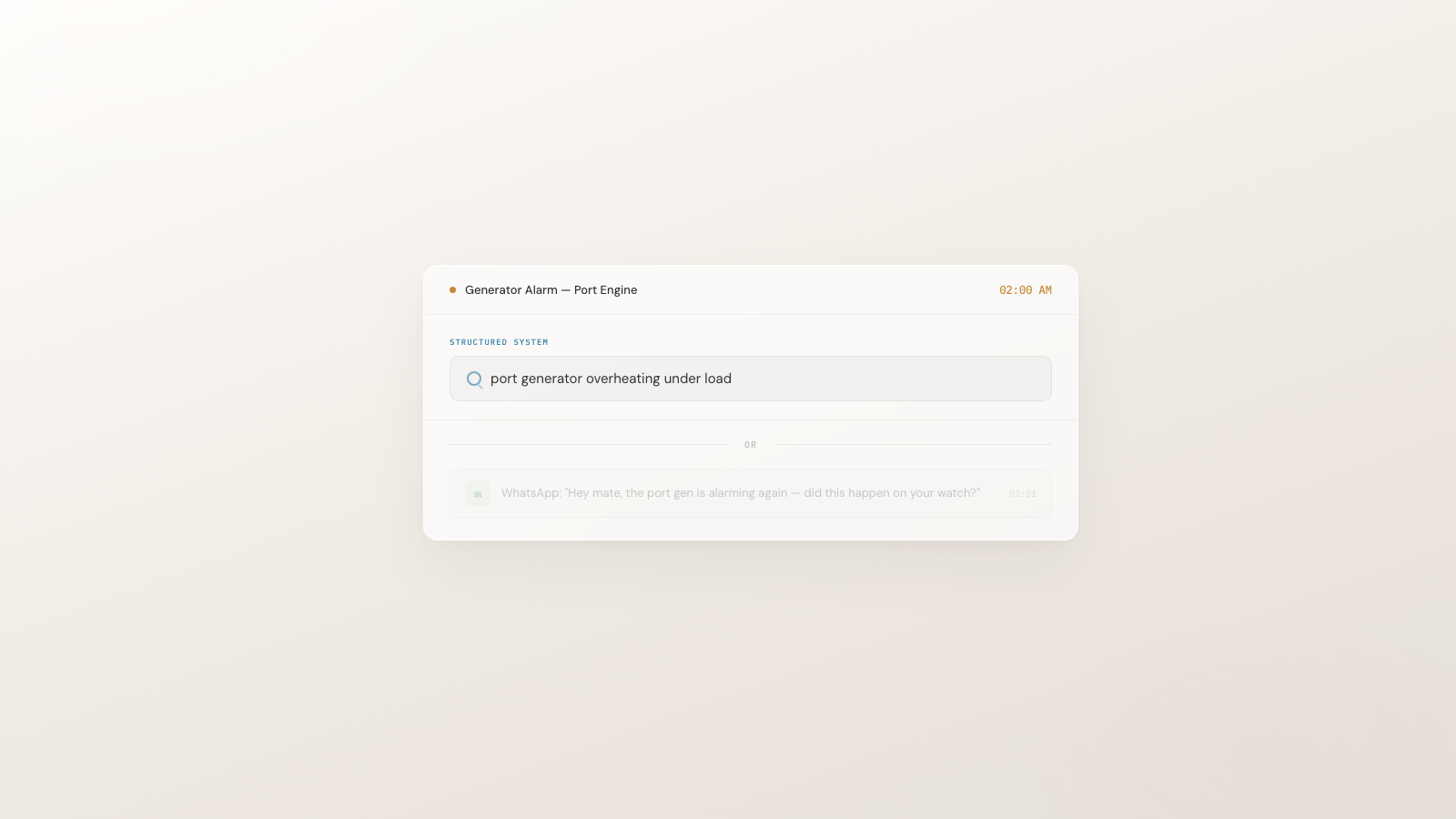
The 2am test that most yacht maintenance software fails
The scenario above is not hypothetical. It is the daily reality on vessels where crews have access to a planned maintenance system but choose not to use it when it matters most.
Under pressure, people bypass structured software. They revert to whatever gives fastest clarity: memory, phone calls, WhatsApp messages, photos stored on personal devices. This is not a training problem. It is not a discipline problem. It is a design problem.
The BTM Group, in their analysis of superyacht software, identified adoption as "the critical constraint" — noting that implementation success depends more on usability than on feature breadth [1]. The implication is direct: a system with comprehensive features that crews do not use under pressure is less valuable than a basic tool they reach for instinctively.
Five reasons yacht crews bypass their maintenance system
The reasons crews bypass their PMS are consistent across vessel sizes, system vendors, and crew experience levels. They are structural, not behavioural.
1. FrictionThe system requires too many steps to reach the information the engineer needs. Module selection, equipment navigation, sub-menus, filter panels — each step adds seconds. At 2am, with a generator alarm sounding, seconds determine whether the engineer uses the system or picks up the phone. Most planned maintenance systems were designed for scheduled office-hours administration. They were not designed for fault response under time pressure.
2. Duplicate entryA generator service is completed. The engineer logs the work order in the maintenance module. Then enters the parts consumed in the inventory module. Then updates the equipment record in the compliance module. The same event, recorded three times in three places, because the system treats each domain as a separate silo [2]. The time spent on duplicate entry is time not spent on the next maintenance task.
3. Training overheadOne chief engineer reported budgeting two full days of every crew rotation exclusively for PMS training [3]. Two days where a qualified engineer is learning software navigation instead of performing maintenance. On a vessel with time-for-time rotation, that training cost recurs every cycle — and the knowledge degrades between rotations because the system is complex enough to require relearning.
When logging maintenance is painful, records fall behind. When records fall behind, the system stops reflecting operational reality. When the system no longer reflects reality, the crew stops trusting it. The BTM Group describes this as "false confidence from incomplete data" — a system that appears functional but whose records are weeks or months behind the vessel's actual state [1].
5. No return on effortCrews enter data into the system but rarely receive value back. The system captures information. It does not help the engineer make decisions. Search is limited to individual modules. Records do not surface related context. The fault history does not link to the parts used, the supplier who provided them, or the warranty status of the equipment. The engineer contributes to the system. The system does not contribute to the engineer.
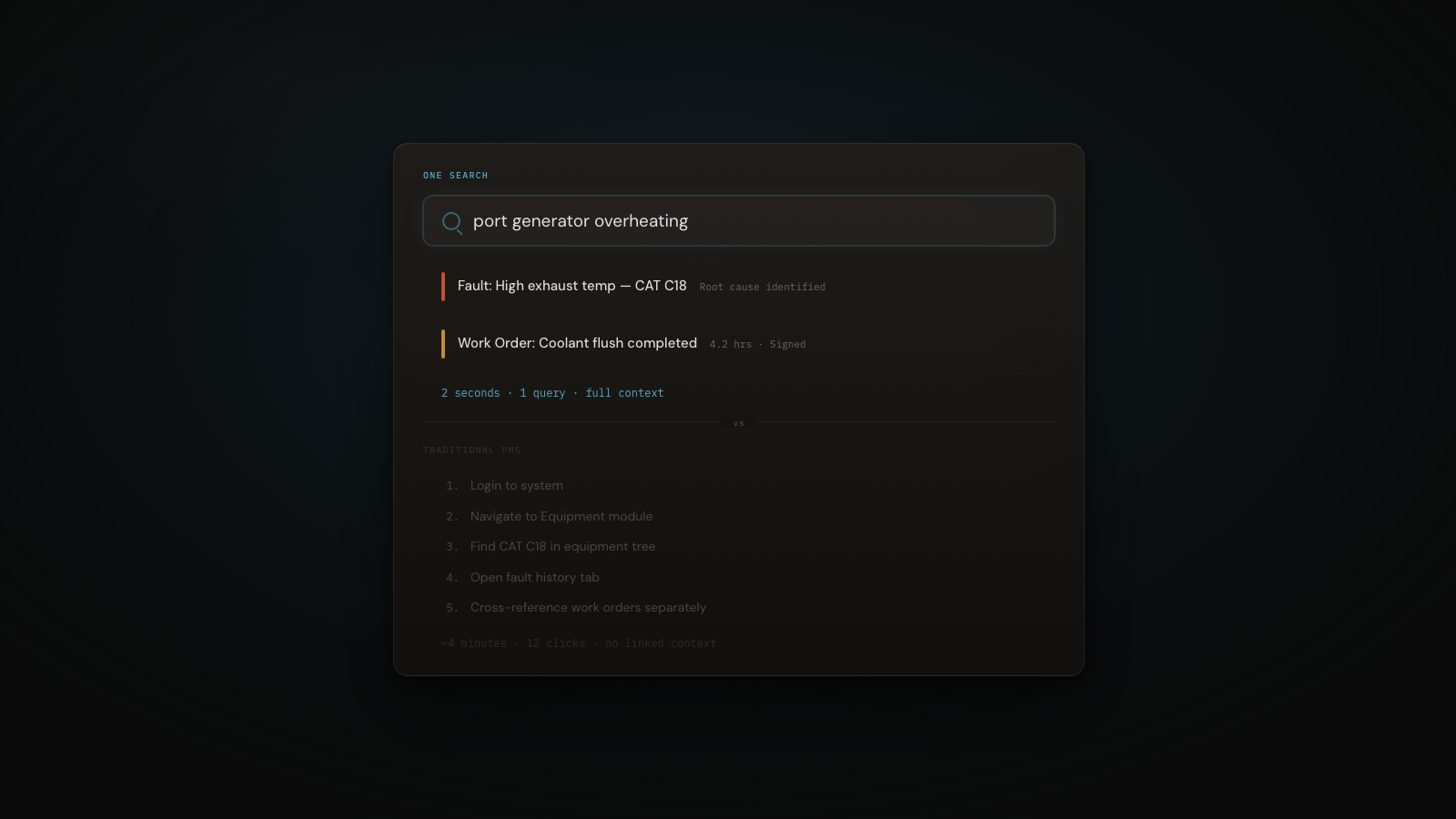
One search, full context in two seconds. Versus twelve clicks across four modules with no linked records. The difference is not features — it is friction.
What yacht crews actually use instead of their PMS
The tools crews reach for when they bypass the official system are consistent across the industry.
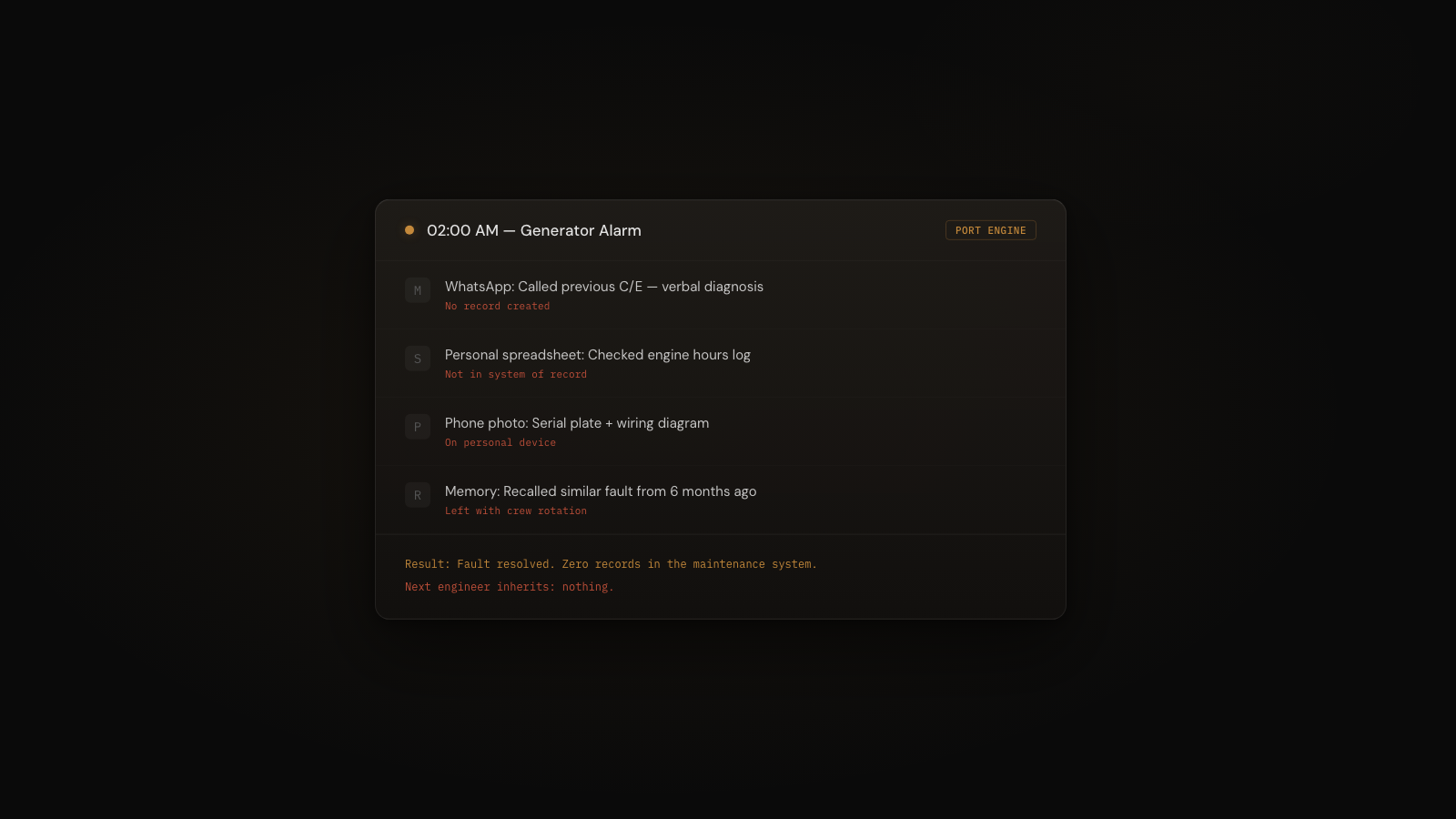
Spreadsheets — for tracking engine hours, inventory levels, and maintenance schedules in a format the engineer controls. WhatsApp groups — for sharing fault photos, coordinating with shore-based technicians, and preserving supplier conversations. Photos on personal phones — for documenting serial plates, wiring diagrams, and equipment configurations. Verbal handovers — for transferring the operational context that the system does not capture. Memory — for recalling fault patterns, supplier reliability, and equipment-specific workarounds that exist nowhere in any system.
These tools are not better. They are faster. They give the engineer immediate access to information without the friction of navigating a structured system that was not designed for how they actually work. As one industry publication observed, some yachts still operate using "WhatsApp messages and hope" [4]. The phrasing is blunt. The reality it describes is common.
The real cost when a superyacht crew bypasses the system
Every bypass has a downstream consequence.
When the engineer records a fault in WhatsApp instead of the maintenance system, the fault history is incomplete. The next engineer, arriving after a crew rotation, has no record of the previous occurrence. The pattern — which would have been visible in connected records — is invisible. The same fault is diagnosed from scratch, at the same cost, for the same equipment, by an engineer with no context.
When maintenance is logged in a personal spreadsheet instead of the official system, the documentation trail that supports a warranty claim is fragmented. The manufacturer asks for timestamped, attributable records from the system of record. The spreadsheet does not qualify.
When handover knowledge is transferred verbally instead of through connected records, the operational context leaves with the departing engineer. The incoming engineer inherits a vessel whose maintenance history is partially in the PMS, partially in spreadsheets, partially in someone else's email archive, and partially in the memory of a person who is no longer aboard.
The bypass is not the problem. It is the symptom of software that was designed for administrative compliance, not for operational reality.
What would make yacht crews stop bypassing their maintenance software
Not more features. Not more training. Not more management pressure to "use the system."
The answer is less friction. A system that loads faster than a WhatsApp call connects. A system where recording a fault takes fewer steps than typing a message. A system where the engineer gets immediate value in return — where logging a fault surfaces the equipment's history, the parts available, the warranty status, and the last three work orders, without the engineer having to search for them.
The answer is work-as-record. A system where the act of doing maintenance and the act of recording maintenance are the same action. Not a separate data entry task performed after the work, under time pressure, often deferred, frequently incomplete — but a natural product of the work itself.
The answer is return on effort. A system where every record the engineer creates makes the system more useful to them — where the fault they log today becomes the context the next engineer finds at 2am six months from now, without anyone having to manually assemble that connection.
The best maintenance system is the one the crew actually uses at 2am. If the system cannot compete with a WhatsApp message and a photo, the system is the problem — not the crew.
Summary
- Yacht crews bypass their planned maintenance system not because of poor discipline but because of poor design — too much friction, duplicate entry, training overhead, data staleness, and no return on the effort of logging records.
- Crews revert to spreadsheets, WhatsApp, photos, and verbal handovers because these tools provide faster clarity under pressure than structured software designed for administrative compliance.
- Every bypass has downstream consequences: incomplete fault history, fragmented warranty documentation, lost handover context, invisible fault patterns, and siloed operational knowledge.
- The solution is not more features or more training. It is less friction, work-as-record design, and a system that returns value to the engineer for every record they create.
- The best maintenance system is the one the crew uses at 2am. If it cannot compete with WhatsApp, the system is the problem.
CelesteOS is a Maritime Technical Intelligence System for superyachts designed around a single principle: the system must be faster and more useful than the workarounds crews resort to. Learn more at celeste7.ai.
[1] BTM Group, "The Good and the Bad of Superyacht Software" — btmgroupci.com
[2] Yachtpedia, "Yacht Management Software: Features, Comparison & How to Choose" — yachtpedia.org
[3] Superyacht Content, "Seahub Blog: Planned Maintenance Systems, 5 Things To Know" — superyachtcontent.com
[4] DeepBlue, Marine Operations Platform — deepblue.app