Nobody opens a dashboard at 2am
The generator alarm sounds at 2am. The chief engineer needs to know if this alarm pattern has occurred before and what was done last time.
The planned maintenance system is technically available. It requires a login, a module selection, navigation to the correct equipment category, a filter for the port generator, and two more clicks to reach the fault history tab. Six steps before a single result appears.
By step three, the engineer has already called the previous chief on WhatsApp.
The PMS did not fail because the data was not there. It failed because the software could not deliver it fast enough. Under pressure, people do not navigate modules. They type what they know and expect an answer.
The problem is not training. The problem is not discipline. The problem is that the software was designed for how administrators organise information, not for how engineers find it.
The design assumption that kills adoption
Conventional maintenance systems are built around modules. A maintenance module. A parts module. A documents module. A defect log. Each with its own navigation tree, its own filters, its own search scope.
This architecture assumes the engineer knows where the information lives before they search for it. At 2am, on a vessel they may have boarded days ago, that assumption fails. The engineer does not know the module structure. They know what they are looking for — "port generator overheating" — and they need an answer.
One chief engineer reported budgeting two full days of every crew rotation exclusively for PMS training. Two days where a qualified engineer learns software navigation instead of maintaining the vessel. On a rotational contract, that training cost recurs every cycle — and the knowledge degrades between rotations because the system is complex enough to require relearning.
The result: management companies pay for software. Crew bypass it. Records fall behind. The system stops reflecting reality. And the cycle repeats with the next rotation.
Type what you think. Get what you need.
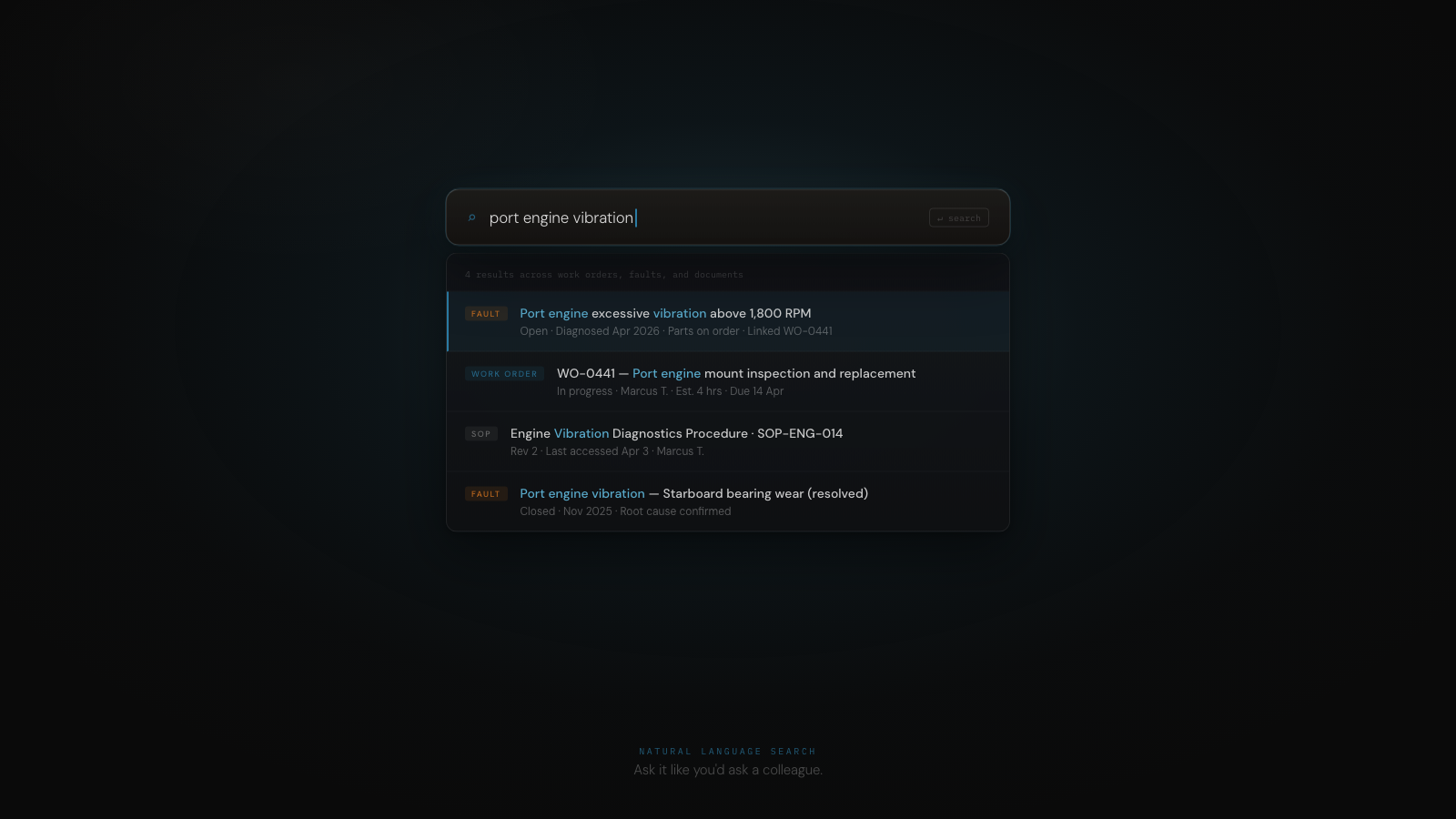
Natural language search eliminates the navigation layer entirely. The engineer types what they are thinking — in the language they naturally use — and the system returns results from every domain simultaneously.
"Port generator overheating" returns: fault history for the port generator showing previous overheating events, work orders related to those faults, parts used in previous repairs, and the manufacturer's technical advisory on operating temperature thresholds. One query. Every domain. No module selection.
"Oil filter main engine" returns: faults related to oil and the main engine, inventory showing current oil filter stock levels, and the engine oil change procedure from the machinery manual. The engineer sees the fault, the parts to fix it, and the procedure to follow — in a single view.
The system parses the query into understood terms and searches across faults, work orders, inventory, certificates, documents, and equipment records simultaneously. The engineer does not need to know that oil filters are tracked in the inventory module while oil leaks are tracked in the fault module while oil change procedures are in the documents module.
There is nothing to learn. The engineer types what they need and the system answers. That is the onboarding.
The priority surface
When the engineer is not searching, CelesteOS does not show a dashboard. It shows a prioritised list of what needs attention right now.
Outstanding faults with severity and age. Overdue maintenance tasks. Certificates approaching expiry. Parts below minimum stock with reorder status. Incoming shipments with expected delivery. Work orders pending sign-off.
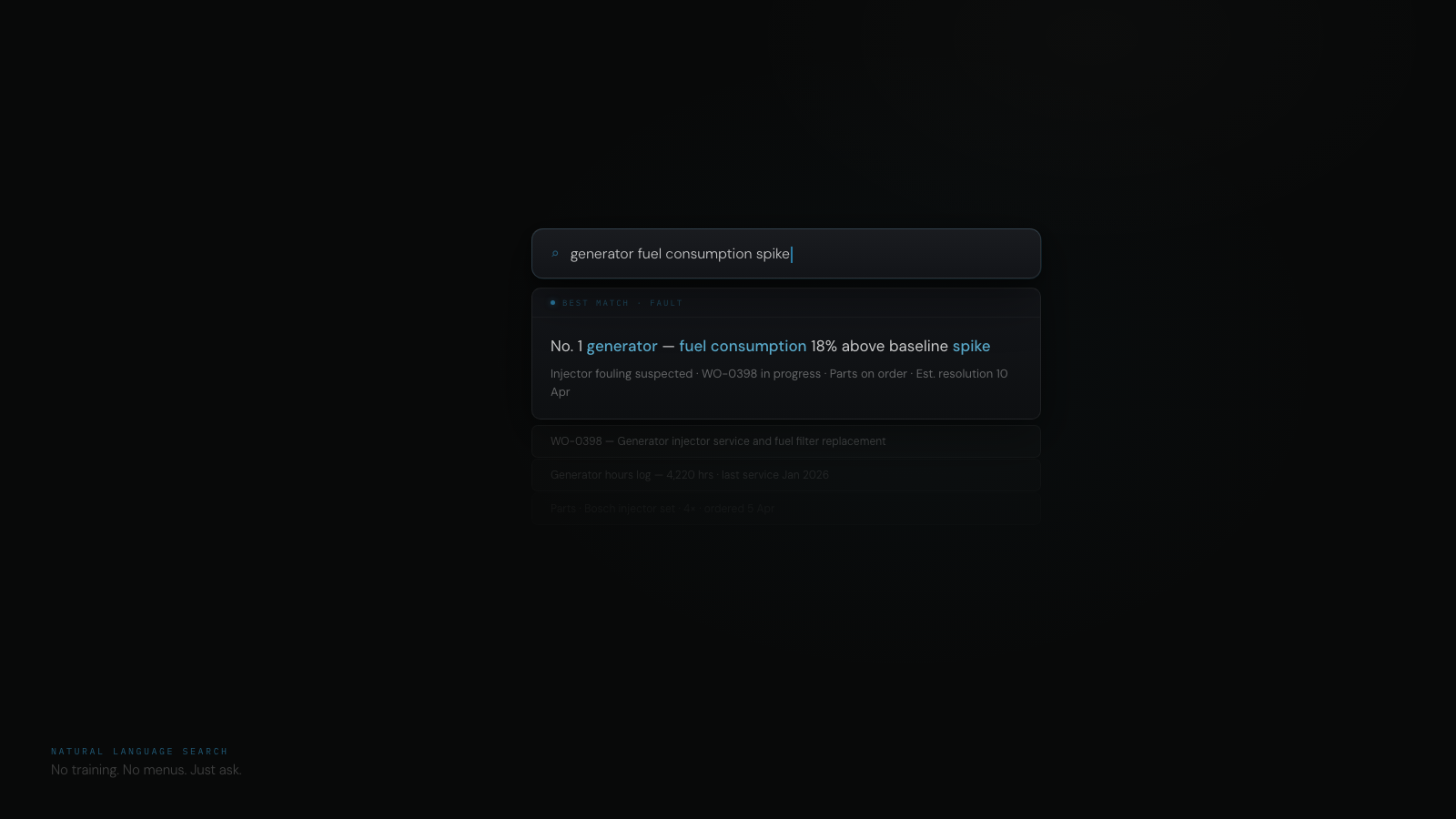
This is not a dashboard — dashboards require interpretation and navigation. This is a priority surface — it shows the engineer what to deal with first, ordered by urgency, updated in real time. The engineer does not navigate to find problems. The problems surface themselves.
When something needs investigation, the engineer types a query. When they need to act, they click the item. See what matters, search for context, act on evidence. No modules. No menus. No learning curve.
Why this changes the adoption equation
CelesteOS is a Maritime Technical Intelligence System for superyachts. Search is the interface — not a feature within the interface.
A chief engineer joining a vessel at 11pm can use CelesteOS immediately. No onboarding session. No training manual. No two-day familiarisation period. The system asks nothing of the engineer except their question.
This changes what adoption means for management companies. Every PMS fails because it demands time from crew before it delivers value. CelesteOS delivers value from the first query. The engineer gets something back immediately — fault history, parts availability, procedures, compliance status. Recording work becomes natural because using the system is faster than the workaround.
The fastest interface is the one you already know how to use
No training. No modules. No learning curve. Type what you need. The system answers.
Every PMS you have paid for has failed because crew will not use it under pressure. This one they use — because it asks nothing of them.
Structured pilot programme
CelesteOS is running a structured pilot across a limited number of vessels. If you manage vessels and adoption has been the barrier, we should talk.
contact@celeste7.ai →