Why the engine room handover is the one that bites
The deck and interior handovers are mostly about routine and preference. The engine room handover is about liability. An outstanding defect, a generator that trips under one particular load combination, a class certificate that expires three weeks into the new chief's rotation — miss any one of them and it resurfaces at the worst possible moment: mid-charter, offshore, or on inspection day with a surveyor watching.
The problem is time. A Seahub survey of superyacht engineers found that 66% of engineering handovers last a week or less, and the outgoing engineer frequently departs before the overlap is even finished [1]. A week is long enough to transfer where things are and how to start them. It is rarely long enough to transfer why — the operational memory that separates competent vessel management from reactive troubleshooting.
The engine room handover, step by step
Work the room in the order an engineer actually thinks in — from the running gear outward to the systems that cause the late-night callouts, then to the paperwork and the people. Use this as the running order for the overlap, and as the contents list for the document you leave behind.
- Walk the space together — cold, then running. Start with a physical walkaround: normal valve line-up, the state of the bilges, and where the leaks you have been watching actually weep. Then start up and let the incoming chief hear the plant under load before you talk over it.
- Hand over the running gear with its history. Main engines, gearboxes, shafts, stabilisers and thrusters: running hours, the oil-analysis trend, and the quirks no manual lists — the main that runs hot on a particular load combination, the coupling alignment that was chased fourteen months ago and how it was solved.
- Power and electrical. Generators and how they parallel, the shore-power changeover, the inverter and battery banks, and any breaker that nuisance-trips. Note which generator is lead, which is standby, and why.
- Fuel, lube oil and tank state. Current soundings, the transfer and purifier routine, the fuel-polishing schedule, and the last bunkering — supplier, quantity, and whether the sample passed.
- Cooling and seawater. Seacocks, strainers, raw- and fresh-water pumps, and every known weep. Where the spare impellers live, and which strainer blocks first when there is weed in the water.
- Auxiliary systems. Watermakers — including the membrane-flush sequence that stops the starboard unit cavitating — bilge and black/grey water, HVAC and refrigeration. The small systems are the ones that ruin a night watch.
- Outstanding defects and work in progress. Every open fault, every half-finished job, and every part still awaited, with its supplier and expected date. This is the list that protects the incoming chief; nothing on it should be a surprise.
- Certificates, surveys and safety systems. Class and statutory items falling due after the rotation, the fixed fire-fighting and bilge-alarm test dates, and the emergency-stop locations. Certificates current and findable on inspection day, not three folders deep.
- Spares, suppliers and the people behind the work. Critical-spares location and minimum levels, the chandlery that actually stocks the right oil filters without a six-week lead time, and the shore electrician who understands the inverter set-up.
- Sign it — both of you. The outgoing chief confirms the state is complete and accurate; the incoming chief acknowledges, in writing, that they have read and understood the operational state of the vessel. A handover nobody signed is a handover nobody owns.
Where most engine room handovers fail
The checklist above is the easy part. The hard part is that on most vessels it lives as a word-processor document or a clipboard, disconnected from the work it describes. A line that reads "watch the starboard chiller" is worth far less than the fault behind it, the work order that addressed it, the part that was fitted, and the manufacturer bulletin cited in the diagnosis. By the time the next chief needs that context, the document is stale and the person who wrote it is on a flight home.
The information existed. It just was not tied to the vessel — it was tied to a document, and to the individual who happened to write it. A handover that survives a rotation has to be a record rather than a recollection, has to resolve back to the underlying work, and has to be searchable by the person inheriting it. For the wider picture of what walks off the boat at every crew change, the cost of that loss is covered separately.
Capturing the handover as you work
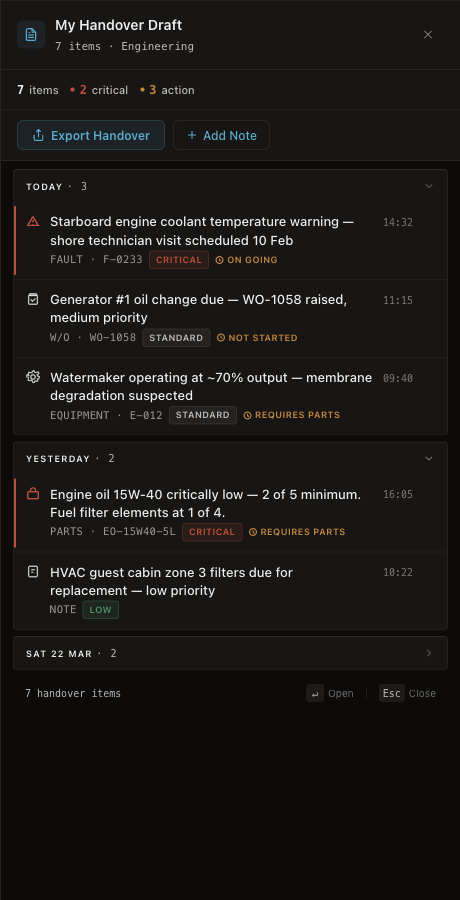
The most reliable engine room handover is the one that was never a separate task. This is where CelesteOS does its quiet work: every record an engineer closes — a fault, a work order, a note — offers a single tap to add it to the handover draft. The draft accumulates as the engineer works, so months of context build up as a by-product of normal work rather than being reconstructed from memory the week before crew change. Dismiss an item and it is never asked twice. Nothing claims to write itself — the system proposes the entry, the engineer decides whether it belongs. It is captured as you work, then reviewed before anyone signs.
Every entry resolves to a live record
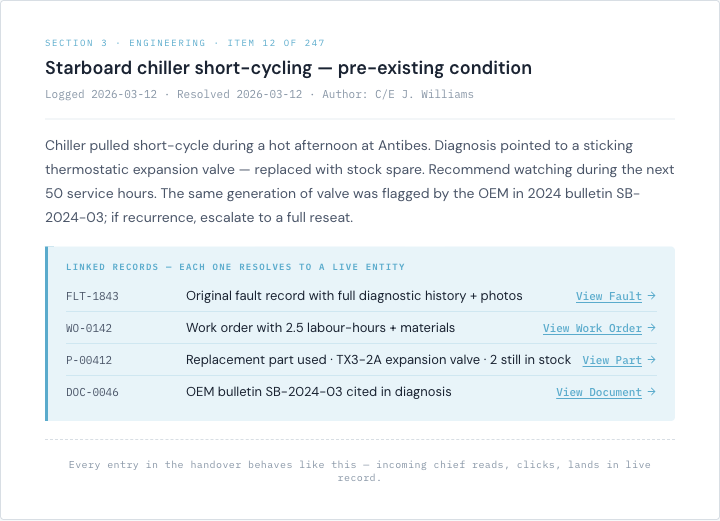
What keeps the draft worth reading is that each line stays connected to the work behind it. Open a single entry — a starboard chiller short-cycling — and the original fault, the work order with its labour hours, the replacement part, and the OEM bulletin cited in the diagnosis are each one click away. Every entry resolves back to a live record. The incoming chief reads the line, follows it, and lands inside the record itself. The handover becomes a live index into the vessel's operational data, not a static document — and the incoming engineer inherits context, not chaos.
Reviewed, then signed by both parties
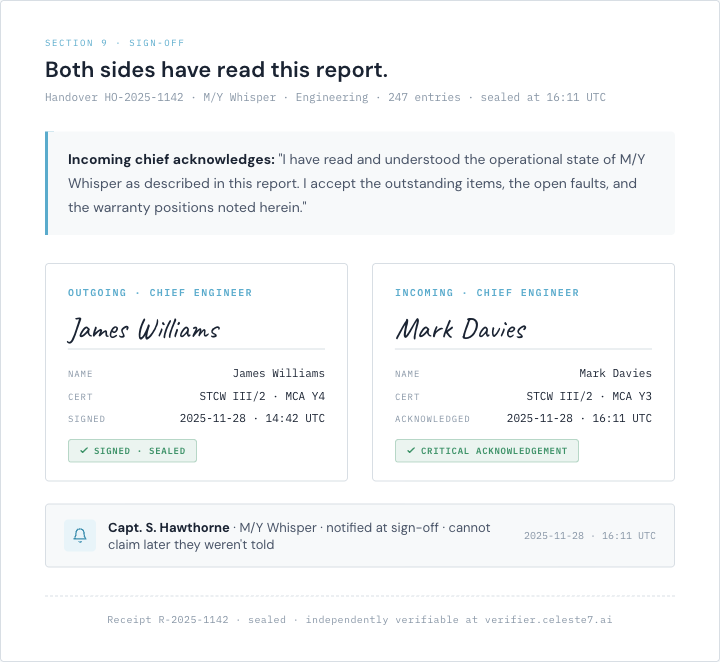
When the rotation comes, the draft is reviewed, not written from scratch. The outgoing engineer reviews it and signs. The incoming engineer acknowledges in writing that the operational state of the vessel has been read and understood. Both signatures are timestamped, and the handover is locked after dual signature. The captain is notified at sign-off, so no one can later claim they were not told, and each record is independently verifiable at verifier.celeste7.ai. The mechanics of the two-signature handover are deliberately plain.
It exports to a report a surveyor can hold
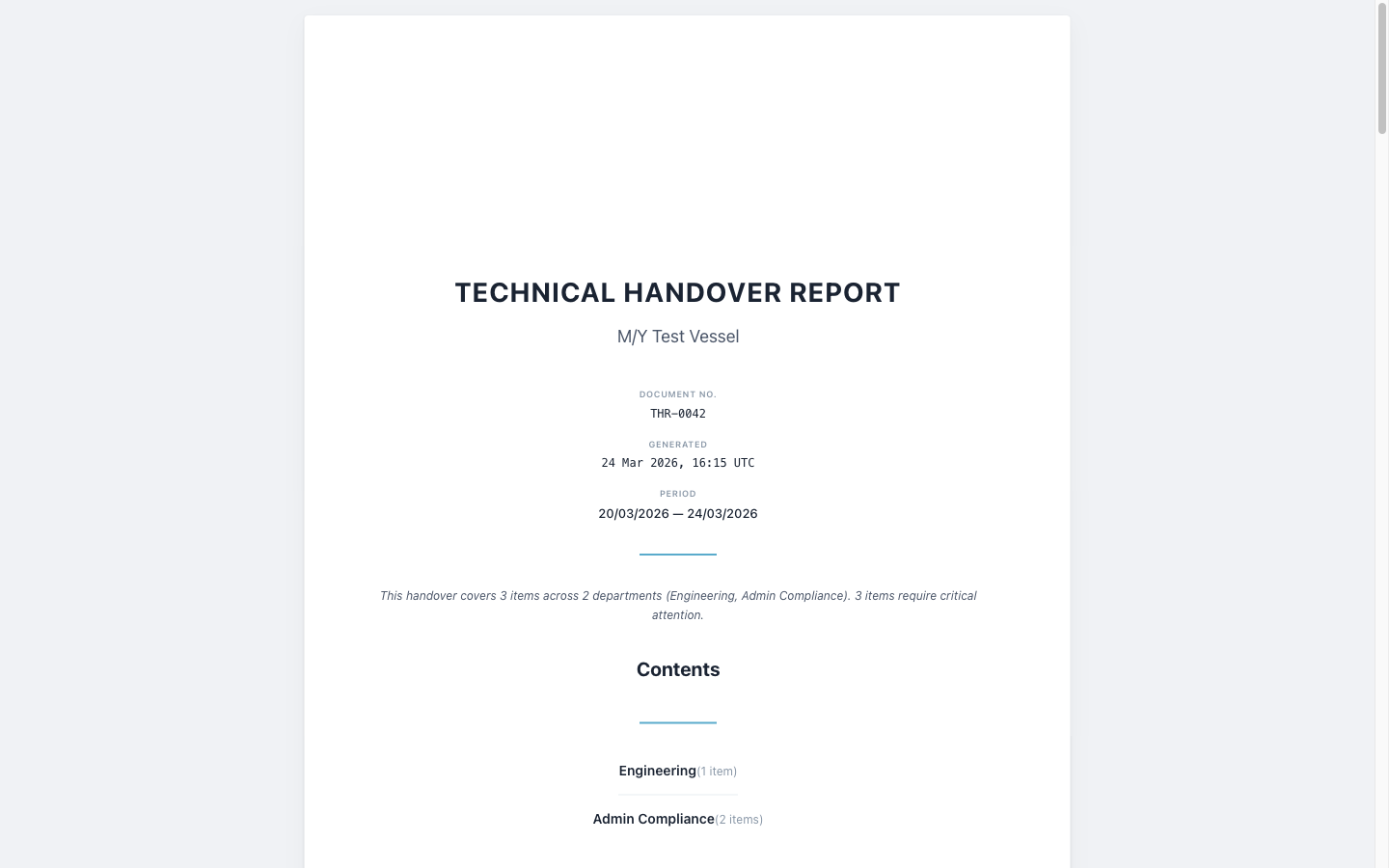
Once both parties have signed, the reviewed draft exports to a formal, dated handover report — document number, the period it covers, and a contents list by department. It reads like a document an auditor or an incoming chief can hold, and every line in it still resolves back to the live record on the vessel. CelesteOS is the planned maintenance system, so the engine room keeps its own memory whichever crew is aboard.
Frequently asked questions
What should an engine room handover checklist include?
At a minimum: the running gear with its hours and known quirks, power and electrical behaviour, fuel and lube-oil state, cooling and seawater systems, the auxiliaries, every outstanding defect and part still awaited, certificates and surveys due after the rotation, and critical-spares and supplier detail. Each item should resolve back to its underlying record rather than living as a flat summary. The guide to a full chief engineer handover covers the structure in detail.
How long should an engine room handover take?
Longer than most get. With the majority of engineering handovers running a week or less, the physical walkaround and the running-gear demonstration tend to crowd out the context that matters most. The way to protect against the short overlap is to stop treating the handover as a one-week event and start capturing it as the work happens, so the document is already current when the rotation arrives.
Does the ISM Code require an engine room handover?
The ISM Code requires vessels to keep records of maintenance activity and to inspect equipment at appropriate intervals [2]. That is a documentation minimum, not a knowledge-transfer standard: it requires that records exist, not that they be searchable, connected, or transferable to the next crew. A structured engine room handover is how you close the gap between what the Code asks for and what the next chief actually needs.
Can a planned-maintenance system replace the engineer's handover?
Not on its own. A planned-maintenance system records that a task was completed; it rarely records why a workaround was needed, or which supplier mistake not to repeat. What software can do is keep the by-product of normal work with the vessel — captured as the engineer closes each record, connected, and reviewed before sign-off. The judgement stays with the engineer. The record stays with the vessel.
Summary
- The engine room handover carries the vessel's liability — outstanding defects, certificate expiries, and the quirks that only live in the outgoing chief's head.
- Most handovers run a week or less, enough to transfer where things are but not why they are done a particular way.
- Work the room in a fixed order — running gear, power, fuel, cooling, auxiliaries, outstanding work, certificates, spares — then sign it, both parties.
- A handover that survives a rotation must be a record not a recollection, resolve back to the live work, and be searchable by the next engineer.
- Captured as you work, reviewed before signing, and independently verifiable — the engine room keeps its own memory whichever crew is aboard.
CelesteOS keeps a superyacht's engine-room knowledge in the vessel — faults, work orders, parts, and handovers, connected and searchable, so context does not leave on the next flight home. Learn about the pilot.
[1] Seahub, "Superyacht Engineering Handover: Good, Bad or Essential?" — seahubsoftware.com
[2] IMO, International Safety Management (ISM) Code, Sections 10 and 11 — marineinsight.com