The handover that wasn't there
A chief engineer joins a 42-metre motor yacht mid-season. The previous chief left two weeks ago. There was no overlap. The handover was a PDF and a WhatsApp voice note that expired before it was listened to.
The main engine has an ongoing vibration above 1,800 RPM. It was diagnosed six months ago. A coupling alignment issue, resolved temporarily with a shimming procedure documented nowhere except in the departing engineer's personal notebook. The notebook left with the engineer.
The relief engineer discovers the vibration on the second day. Calls a marine technician. The callout costs EUR 3,500. The diagnosis: coupling alignment — the same fault, solved before, at half the cost, by the person who is no longer aboard.
This is not an unusual scenario. It is the standard one.
The problem is not the engineer. It is the system.
Crew rotation on superyachts is a constant. Nine in ten chief engineers work on rotational contracts. Junior crew turnover exceeds 37% annually. A vessel's engineering team may change entirely within a two to three year cycle.
Each transition is a potential loss of operational context. Fault history, supplier intelligence, maintenance nuance, warranty documentation — all of it accumulated over months of daily work, all of it tied to the individual who created it.
The departing engineer is not negligent. They are operating within a system that was never designed to capture what they know. Planned maintenance systems record tasks. They do not record context. The difference between the two is the difference between a maintenance log and operational intelligence.
What should transfer at every crew rotation
A structured engineering handover pulls from every operational domain on the vessel:
Outstanding faults with full context. Not a list of open defects — the diagnosis history, what was tried, what worked, what did not, and who the manufacturer recommends contacting.
Work orders in progress. Current status, parts on order, expected completion, dependencies on yard visits or supplier deliveries.
Equipment notes. The operating characteristics that are not in the manual — the generator that runs hot under specific load conditions, the watermaker sequence that prevents cavitation, the stabiliser alarm that is normal for this vessel.
Supplier contacts with correspondence. Which chandlery delivers on time. Which shore electrician understands the vessel's inverter setup. Which manufacturer's warranty department requires a specific documentation format.
Compliance timeline. Certificates approaching expiry. Flag state surveys due. Classification requirements that need attention before the next inspection.
Prioritised actions. What the incoming engineer needs to deal with first, second, third — tagged by urgency, with linked records for each.
Every item hyperlinked to the exact source record. The handover is not a static document — it is a live index into the vessel's operational data.
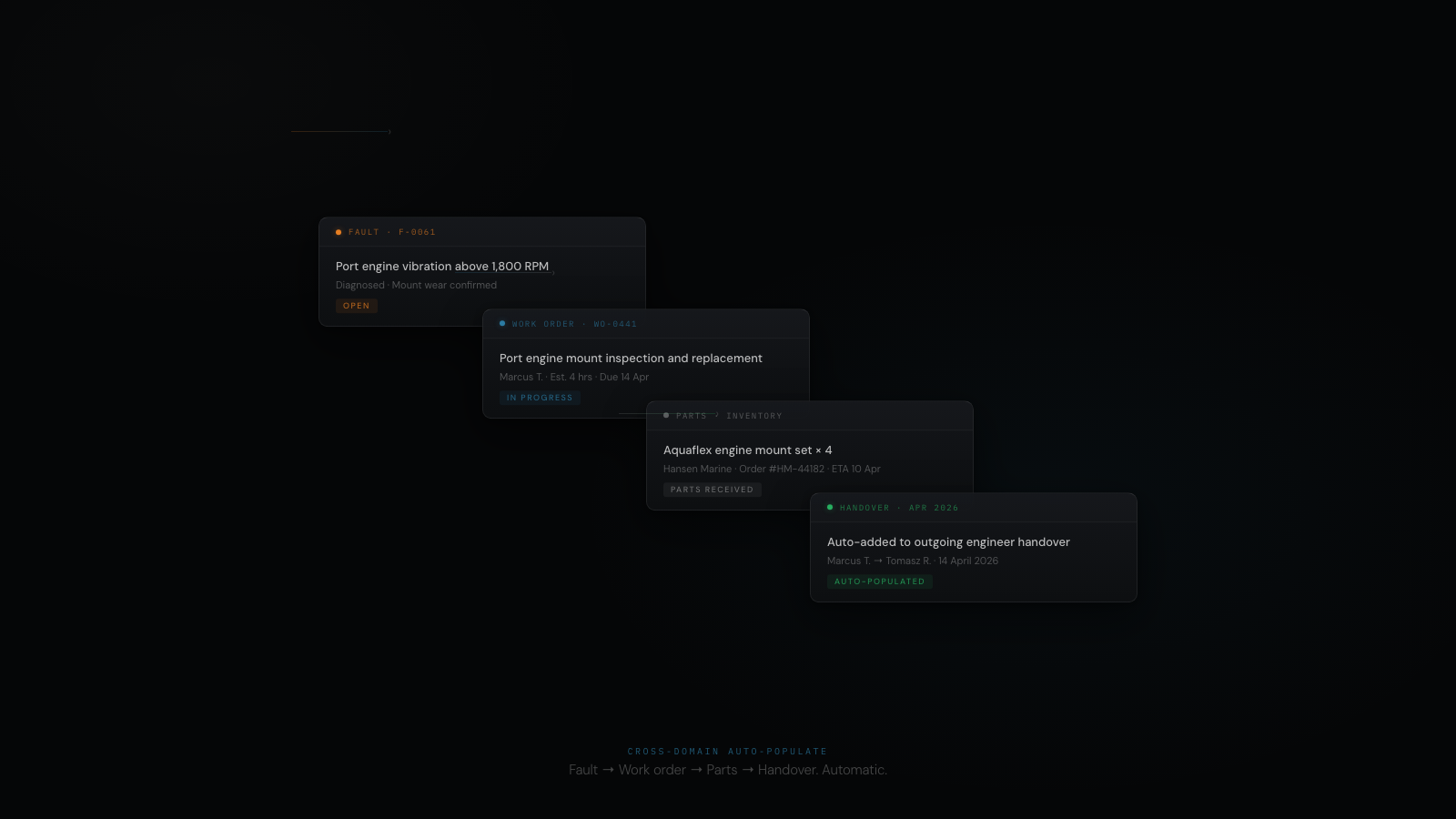
How this document is generated
CelesteOS is a Maritime Technical Intelligence System for superyachts. It sits alongside the vessel's certified PMS — capturing the operational knowledge that maintenance systems cannot. As crew work — logging observations, recording handover notes, annotating equipment, preserving supplier context — every action is connected across domains and preserved in a searchable vessel knowledge base.
The handover document is not assembled manually. It is compiled automatically from the vessel's operational records at the moment of crew transition. Every item in the handover links directly to its source record in the system. The incoming engineer can follow any item — a fault, a work order, a pending parts order — to its complete operational context with one click.
The handover is a product of how the vessel is managed, not an additional task performed under time pressure.
What operational continuity looks like
The vessel already knows its history when the new engineer arrives. The fault patterns, the supplier relationships, the compliance deadlines, the equipment-specific procedures — all searchable, all linked, all preserved regardless of who created them.
Structured pilot programme
CelesteOS is running a structured pilot across a limited number of vessels. If you manage vessels and want to see what this looks like on a real programme, we should talk.
contact@celeste7.ai →