The fault that kept returning
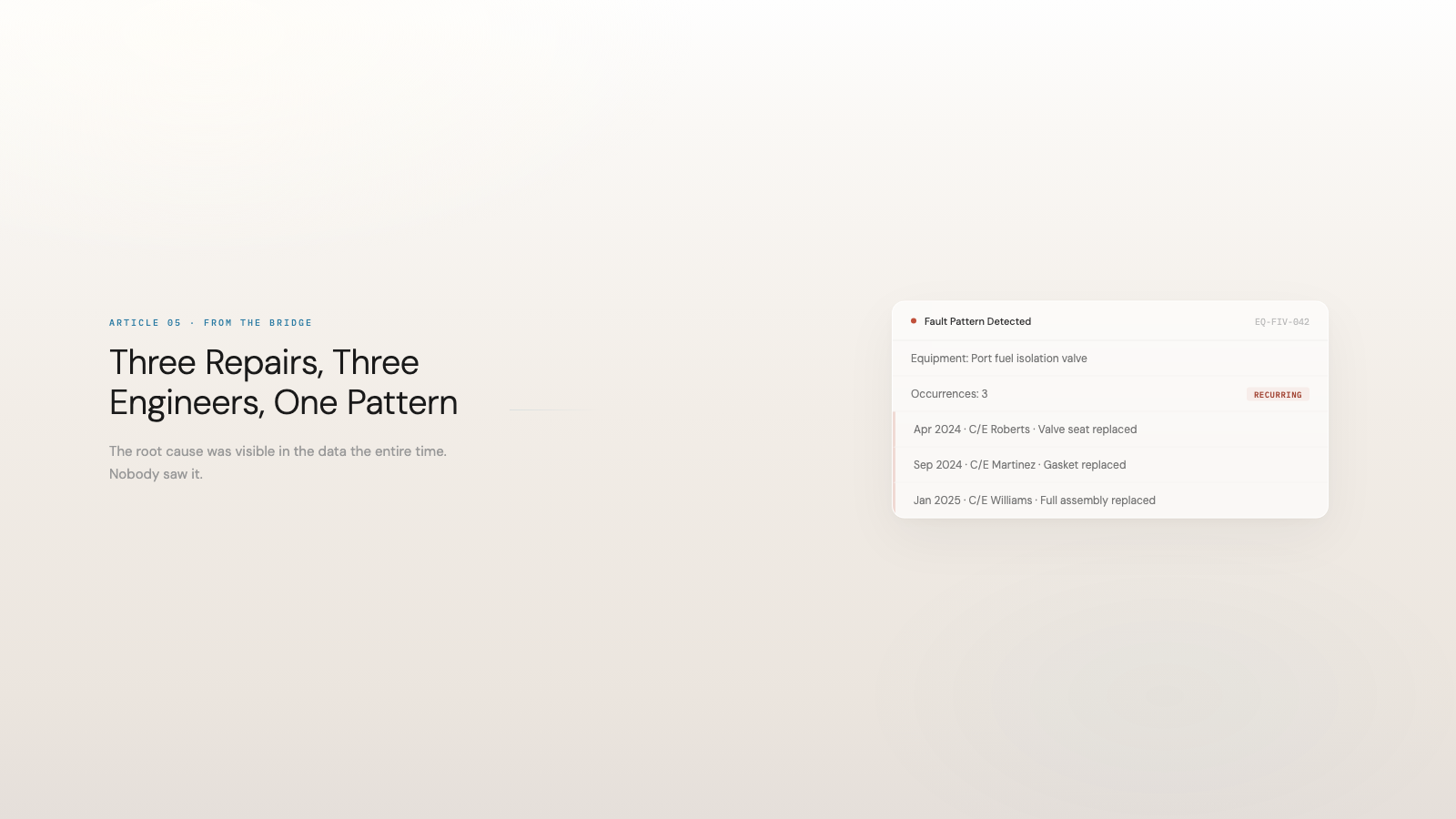
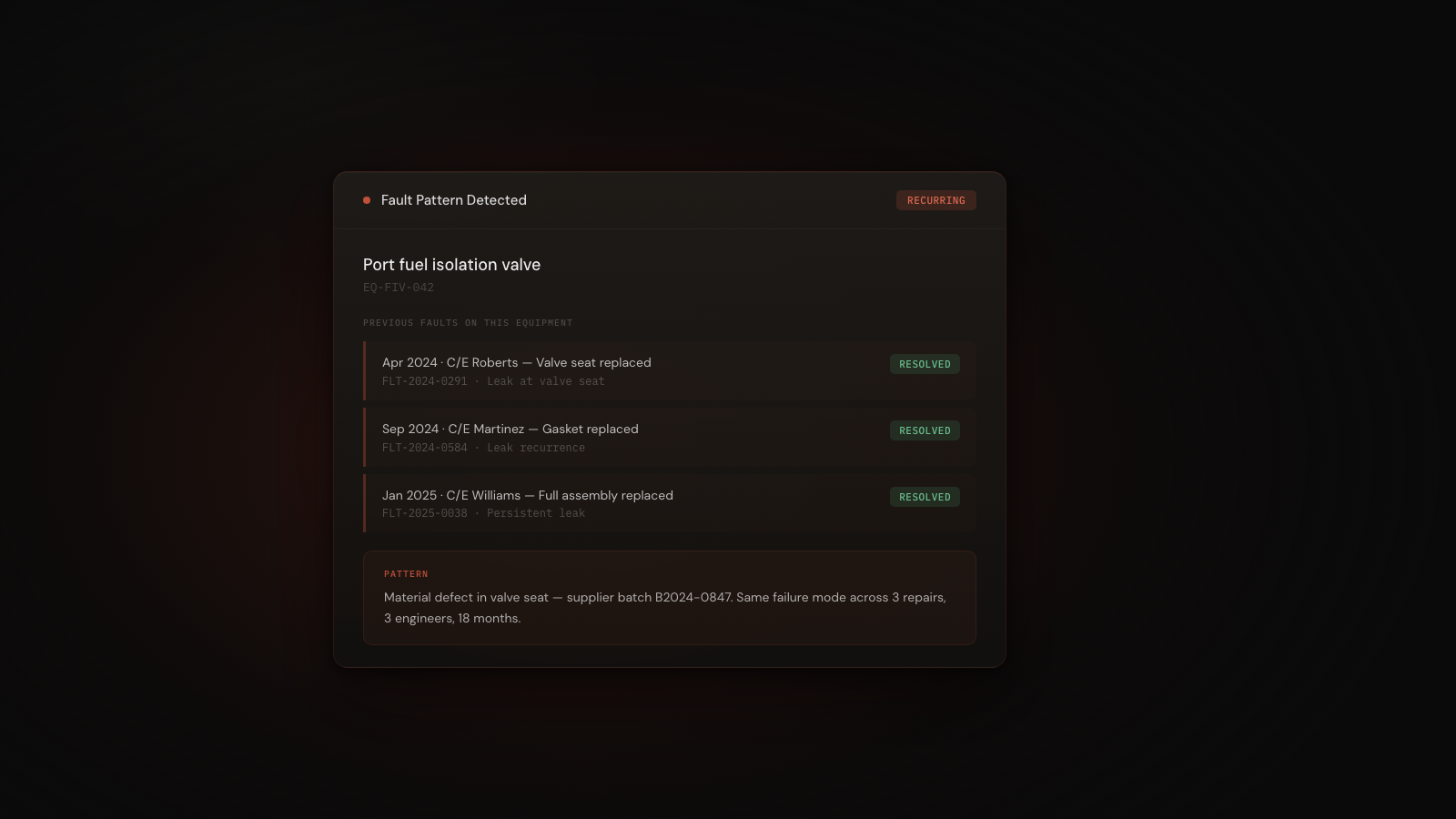
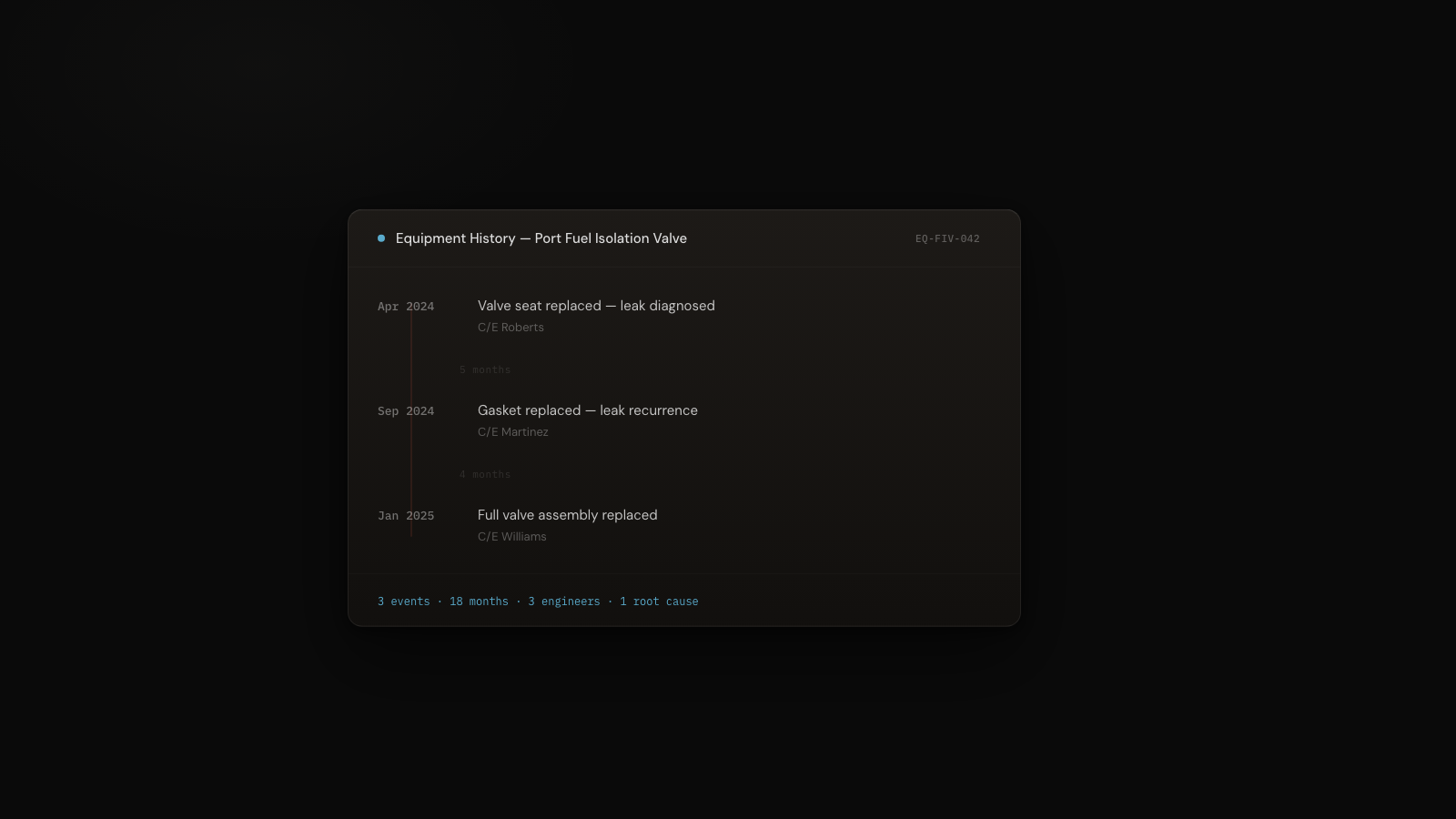
The first repair was in April. The engineer diagnosed a leak, replaced the valve seat, logged the defect, and closed the work order. The second repair was in September, five months later, after the engineer had rotated off. The relief engineer found the same valve leaking, diagnosed a gasket failure, replaced the gasket, and logged a new defect. The third repair was in January, handled by a third engineer who replaced the entire valve assembly after concluding the component was unreliable.
Three defect records. Three work orders. Three sets of parts consumed. Three separate entries in the planned maintenance system, each documenting what happened and what was done. None of them connected to each other. None of them surfacing the fact that this was the same failure, recurring on the same equipment, with an identifiable root cause.
The pattern — a material defect in the valve seat supplied by a specific chandlery — was present in the data from the second occurrence. But the data lived in three separate defect records, created by three different engineers, across two crew rotations, in a system that stores faults as individual events rather than connected sequences.
The difference between a fault log and a fault pattern
A fault log records what happened. It documents the defect, the date, the location, the diagnosis, and the corrective action. It is a record of an event.
A fault pattern reveals why the same thing keeps happening. It connects events across time, across crew rotations, and across equipment to surface systemic causes that individual log entries cannot show.
Every yacht planned maintenance system on the market offers a defect log. The engineer reports a fault, describes the symptoms, documents the repair, and closes the record. The Nautical Institute's marine accident reporting system documents cases where undetected pre-existing flaws — such as fatigue cracking in engine components — caused cascading failures precisely because the pattern of degradation was not visible in isolated maintenance records [1].
The distinction matters because a defect log answers the question the engineer asks today: "What is wrong and how do I fix it?" A fault pattern answers the question the vessel needs answered: "Why does this keep happening and what will happen next?"
Four reasons fault patterns stay invisible on superyachts
Fault patterns are not invisible because engineers are inattentive. They are invisible because of structural conditions that exist on every superyacht with crew rotation and a conventional maintenance system.
Crew rotation breaks continuityThe engineer who handled the first repair is not aboard for the second. The context they built — the troubleshooting steps they tried, the components they inspected, the suspicions they formed — left when they did. The relief engineer approaches the fault with no history, no prior context, and no awareness that it has occurred before. Consistent records help spot trends in fuel use, engine performance, and recurring defects — but only if the records are connected and the person reading them can see the full sequence [2].
Siloed systems hide connectionsThe fault record exists in the defect log. The parts used in the repair exist in the inventory system. The supplier who provided the valve seat exists in the purchasing records. The warranty status of the equipment exists in the certificate tracker. Each system stores its own data. None of them cross-reference the others. The pattern that connects a specific supplier's component to a recurring fault on specific equipment requires information from all four systems — and no single system provides it.
Time gaps exceed human memoryFive months between the first and second occurrence. Four months between the second and third. Each gap is long enough that the current engineer has handled dozens of other tasks in between. Without a system that flags the recurrence, the connection between events depends on individual recall — which is unreliable across months and impossible across crew changes.
Record format prevents analysisMost defect logs store fault descriptions as free text. "Valve leaking, replaced seat." "Gasket failure, replaced gasket." "Valve assembly unreliable, replaced unit." These entries are readable by a human reviewing them one at a time. They are not structured in a way that allows a system to recognise that three entries describe the same recurring failure on the same equipment. The information exists. The format buries it.
A recurring fault pattern surfaced across crew rotations — three separate defect records connected to the same equipment, revealing a systemic root cause that individual log entries could not show.
What fault patterns reveal that individual logs never will
When faults are connected across time and context rather than stored as isolated records, four categories of insight emerge that are invisible in individual defect entries.
Same equipment, different symptoms — systemic root causeA watermaker that fails for three apparently different reasons over 12 months may have a single underlying cause: a degraded membrane that manifests differently depending on operating conditions. The individual logs show three different faults. The pattern shows one root cause.
Same part failing across multiple equipment — supplier or batch issueIf three different systems aboard the same vessel experience failures involving components from the same supplier or the same manufacturing batch, the individual defect logs show three unrelated equipment failures. The pattern reveals a procurement problem.
Faults clustering after specific maintenance events — procedural errorIf a particular type of fault tends to occur within two weeks of a specific maintenance procedure, the pattern suggests the procedure itself is introducing the problem. Individual logs show post-maintenance failures. The pattern shows a systematic process error that will recur until the procedure is corrected.
Seasonal patterns — environmental factorsEquipment that fails reliably during Mediterranean summer operations or North Sea winter passages may be responding to environmental conditions that the maintenance schedule does not account for. Individual logs show seasonal breakdowns. The pattern reveals that the maintenance interval needs to be adjusted for operating conditions, not calendar time.
The cost of pattern blindness on a superyacht
A recurring fault that is logged three times but never connected is a denied warranty claim waiting to happen. When the manufacturer asks for the full fault history on a piece of equipment and receives three disconnected defect records with no linked root cause analysis, the claim investigation stalls on exactly the documentation gap that the system created.
The engineer who recognised the pattern — who suspected, during the second repair, that the valve seat material was the problem — left at the next crew rotation. Their suspicion was not documented as a structured hypothesis linked to the equipment record. It was a mental note, perhaps mentioned during a verbal handover, certainly not searchable by the next engineer six months later.
The cost is not limited to the warranty claim. It includes the three separate repair events that could have been one definitive repair if the pattern had been visible after the second occurrence. It includes the parts consumed in temporary fixes. It includes the engineering hours spent diagnosing the same root cause three times. And it includes the operational risk of equipment that continues to fail because the underlying cause remains unaddressed.
A fault log answers "what happened." A fault pattern answers "what will happen next." The difference between the two is whether the system records events or reveals connections.
Summary
- Fault patterns — recurring failures connected across time, equipment, and context — are systematically invisible on superyachts due to crew rotation, siloed systems, time gaps between occurrences, and unstructured record formats.
- Every yacht maintenance system offers a defect log. Almost none surface the patterns that explain why the same faults keep recurring.
- Four categories of insight are invisible in individual logs: systemic root causes, supplier or batch issues, procedural errors introduced by maintenance events, and seasonal environmental patterns.
- Pattern blindness has direct financial consequences: repeated repair costs, denied warranty claims from disconnected documentation, and ongoing operational risk from unresolved root causes.
- The critical distinction: a fault log records what happened. A fault pattern reveals what will happen next.
CelesteOS is a Maritime Technical Intelligence System for superyachts where fault records are connected to equipment history, parts, work orders, and supplier data — making recurring patterns visible across crew rotations. Learn more at celeste7.ai.
[1] The Nautical Institute, MARS Report 200853: "Main Engine Failure" — nautinst.org
[2] MyYachtManagement, "Yacht Recordkeeping Made Simple: Logs, Checklists and Digital Tools" — myyachtmanagement.com