Maintenance management is a records problem before it is a mechanical one
A chief engineer on a 50-metre motor yacht is not short of maintenance activity. There is a planned-maintenance schedule to service, defects to raise and close, parts to source, certificates to keep current, and manufacturers to correspond with when something behaves outside its manual. The work gets done. What is harder is keeping the record of that work coherent — so that six months later, or after a crew change, anyone can reconstruct what happened and why.
The typical setup scatters the answer. The planned-maintenance system holds the schedule. Defects sit in a separate log or a notebook. Parts are tracked on a spreadsheet, if at all. Manuals live on a shared drive nobody has reorganised since the last yard period, and the most useful context — the workaround, the supplier who actually delivers, the torque figure that fails the gasket on this installation — sits in email threads and one person's memory. Each piece is recorded somewhere. None of it is connected.
That fragmentation is why maintenance management on a yacht so often feels like archaeology. The task is not doing the work; it is finding what the vessel already knows before you repeat it. This is the same failure that turns a crew change into a knowledge-loss event — the information exists, but it is not retrievable by whoever needs it next.
The four things a maintenance system has to keep straight
Reduced to essentials, managing maintenance on a superyacht means keeping four kinds of record legible and connected to each other.
Faults, and what it cost to solve them last time
A fault raised, diagnosed, and closed is only half the value. The other half is the diagnosis itself — the cause, the procedure, the hours it took — so that when the same symptom returns eighteen months later, the vessel does not pay a marine technician to solve a problem it has already solved once. What you want from a fault record is its history: the prior occurrences surfaced alongside the current one, not a snippet buried in an archived log.
Work orders tied to the fault that triggered them
A work order in isolation records that a job was done. A work order connected to its originating fault, the part fitted, and the labour hours records why the job was done and what it resolved. The connection is the point. A maintenance history that reads as a flat list of completed tasks tells the next engineer almost nothing; one where each task resolves back to its cause tells them everything.
Parts, with stock and a physical location on board
Half the delay in a repair is not the diagnosis — it is finding out whether the part is aboard, and if so, where. A parts record worth keeping shows stock against a minimum at a glance, and the physical location of the box on the shelf, so a night-watch engineer is not searching three lockers at 2am. Tie the part to the work order that consumed it and the equipment it serves, and the maintenance picture closes.
Certificates and manuals, findable when they are needed
Certificates tracked to expiry, with renewal dates and the source PDF attached, keep inspection day calm. Manuals matter for the same reason: the machinery procedure is worth nothing if nobody can find it under a filename the last crew invented. The measure of a maintenance system is not whether the document exists — it is whether the engineer in front of the equipment can retrieve it.
Where the standard tools fall short
Most planned-maintenance systems are good at the schedule and poor at everything around it. They treat maintenance as a series of isolated events: a work order is closed, a part is replaced, a certificate is renewed, each logged on its own. The connections between them — the fault that led to the work order, the part substituted because the original was discontinued, the certificate expiring three months after the next rotation — are captured in no system. They exist only in the engineer's head, and the head leaves on a Tuesday.
The information already exists, in other words. It fails not because it was never recorded but because it was recorded in fragments, in formats nobody can search, tied to individuals rather than to the vessel. Solving that is a design problem more than a technology one: keep the records connected, and make them retrievable in the language an engineer would actually use to ask.
Finding what the vessel already knows
The practical test of a maintenance system is the 2am one. Something is wrong with the seawater cooling, the engineer half-remembers a similar fault last season, and they need the record now — not after navigating a menu tree hoping the previous crew filed things where they would have.
This is where natural-language search earns its place. Instead of remembering which module holds what, the engineer types what they'd ask a colleague — "oil leak port engine", "impeller cooling pump" — and gets the records back. The search returns the record, not a snippet; every result is a live record, and one click lands on the actual work order — status, history, parts. It finds what you mean, not what you typed, and there is nothing to learn: the engineer types what they need. Results are scoped to your vessel and role — no filter to set up first.
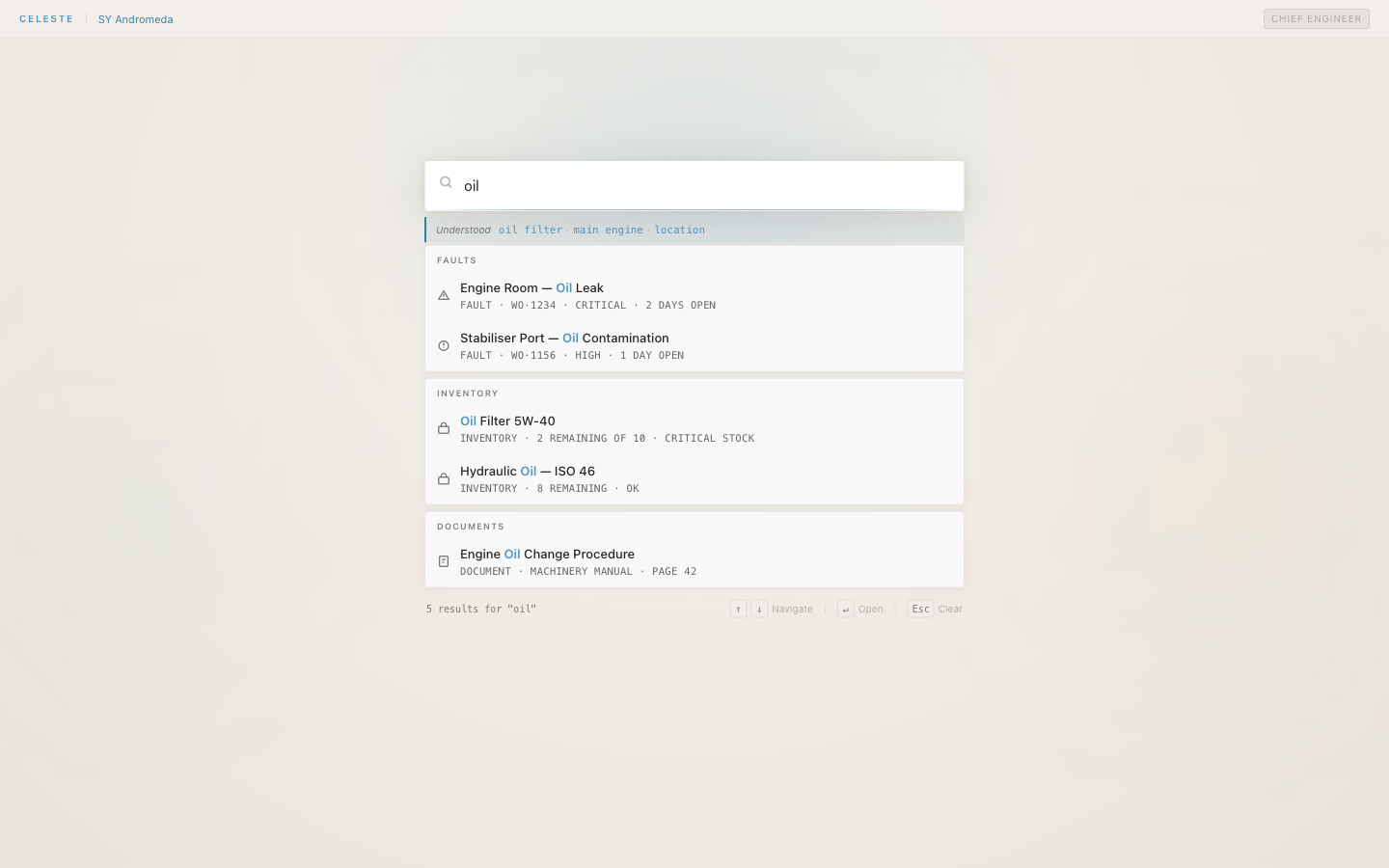
The point is not cleverness. It is that the by-product of a year's normal work stays retrievable by whoever inherits the boat. Search lives at the top of every screen — phone, tablet, laptop — so the record is reachable from the engine room, the bridge, or a hotel on rotation. Fast enough to use at 2am.
One record, and everything connected to it
Search gets you to a record. What makes maintenance management coherent is what happens next: open any record and CelesteOS surfaces what's related — work orders, parts, equipment, and handovers. Following one record leads to every connected record, so the engineer stays oriented without leaving the page.
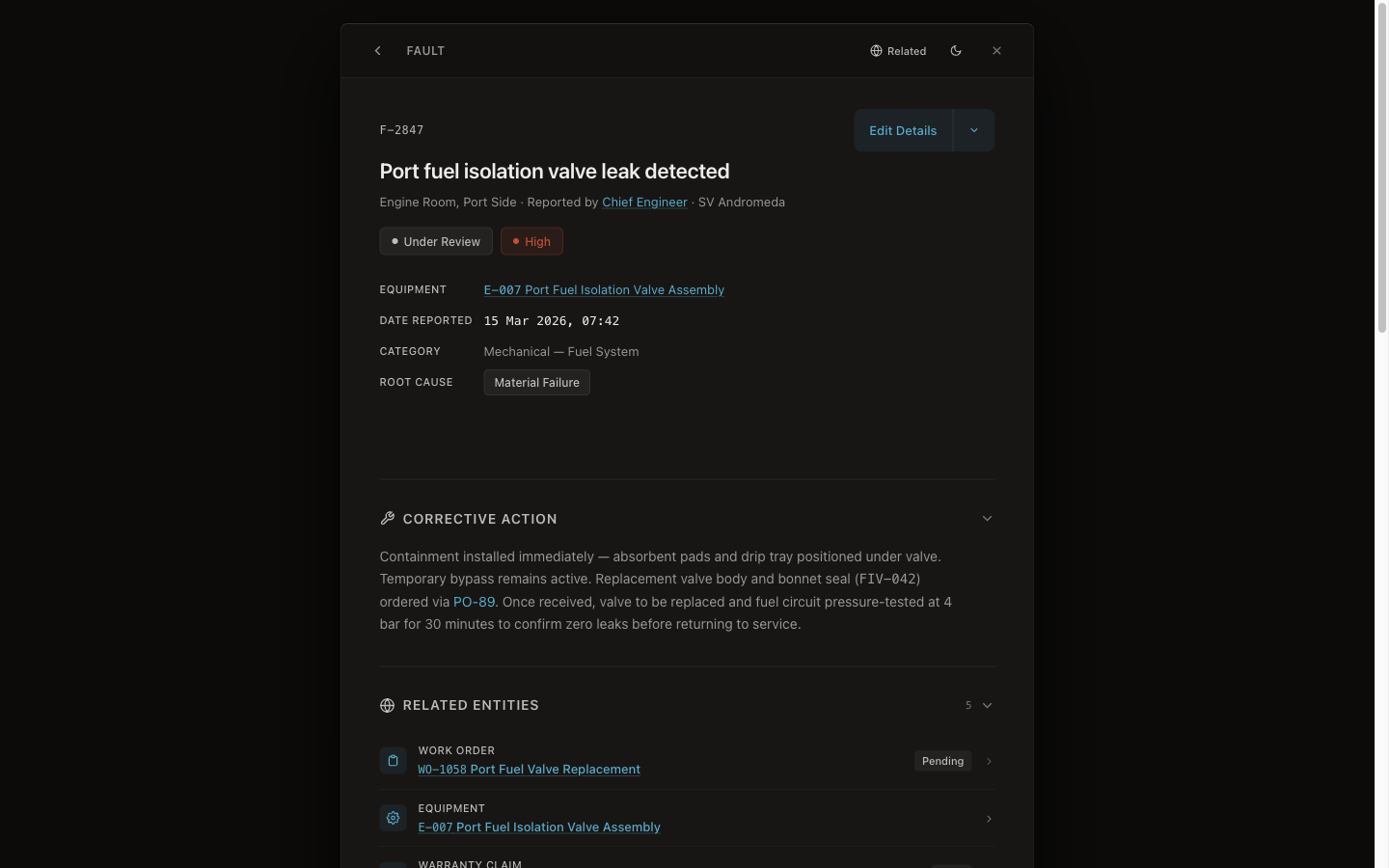
Open a fault and the related work order, the equipment, and the warranty claim are one click away. The corrective action lives on the record itself, not in someone's recollection of it. This is the moment where a scattered maintenance history becomes a single connected picture — the fault, the fix, the part, and the proof, each a link rather than a memory. Documents connected to the work they describe help too: the right manual surfaces on the entity card, and the engineer accepts or denies the link with one tap.
Parts close the loop. A part record shows its stock against a minimum and the physical location of the box on board, with the OEM number and supplier on the same record. When maintenance is managed this way, whether the impeller is aboard, and where it is, is known before the engineer leaves the workshop.
Managing maintenance so the record outlasts the crew
The reason all this matters is continuity. A vessel's engineering team can turn over entirely inside a two-to-three-year cycle, and each transition is a chance to lose operational context. A maintenance system that keeps its records connected, attributed, and searchable turns that transition from a cliff into a step. Every action — logging a fault, creating a work order, signing a handover — is attributed by signed-in user and role, and timestamped. The trail is append-only: nothing is overwritten, and corrections are recorded as new entries that reference the original.
That append-only history is also what stands up on inspection day. A vessel that can produce complete, connected maintenance records during a flag-state or Port State Control inspection turns audit prep from an assembly job into a retrieval one. CelesteOS is the planned maintenance system, and the records it holds are independently verifiable at verifier.celeste7.ai. The framing is deliberately plain throughout: the system proposes, the engineer decides. Nothing executes without explicit consent.
For the mechanics of keeping manuals and records findable in the first place, see the guide to organising a yacht's manuals and records for search.
Frequently asked questions
What is the best way to manage maintenance on a superyacht?
Keep the schedule, faults, parts, certificates, and manuals connected rather than in separate systems, and make the whole thing searchable in plain language. The single biggest failure in yacht maintenance management is not missing tasks — it is that the connections between records live in one engineer's head and leave when they rotate. A system where every record resolves back to its cause, and where the incoming engineer can search what the vessel already knows, keeps maintenance coherent across crew changes.
Can existing records be brought into CelesteOS?
Yes. CelesteOS is the planned maintenance system. Your existing manuals, PDFs, scans, and exports are imported as they are, without a reformatting exercise, and the pilot includes importing the equipment register, certificates, and work-order history.
How can maintenance knowledge be kept from leaving with the crew?
Tie the knowledge to the vessel rather than the individual. Records captured as the crew works, connected to each other and searchable in plain language, stay with the boat when the engineer rotates. The judgement still leaves with the person; the record does not. This is the difference between a maintenance history that reads as a flat log and one the next engineer can actually use.
What should show up on a single maintenance record?
Enough to reconstruct the work without asking anyone. A good fault record carries its corrective action and its prior occurrences; a work order carries the fault that triggered it, the part fitted, and the labour hours; a part carries its stock, location, supplier, and OEM number. When a record is opened, what's related to it should surface alongside — so one record leads to every record connected to it.
Summary
- Managing maintenance on a superyacht is a records problem before it is a mechanical one — the work gets done; keeping the connections between records coherent is the hard part.
- Four kinds of record have to stay legible and connected: faults with their history, work orders tied to their cause, parts with stock and location, and certificates and manuals findable on demand.
- Standard tools log events in isolation; the connections between them live in the engineer's head and rotate off the boat.
- Natural-language search returns the live record, not a snippet, and lands one click from the actual work order — reachable from any screen.
- Opening a record and surfacing what's related turns a scattered history into one connected picture that outlasts the crew, attributed, append-only, and independently verifiable.
CelesteOS keeps a superyacht's maintenance record connected and searchable — faults, work orders, parts, and manuals, tied to the vessel rather than the crew, so context does not leave on the next flight home. Learn about the pilot.
[1] Seahub, "Superyacht Engineering Handover: Good, Bad or Essential?" — seahubsoftware.com
[2] IMO, International Safety Management (ISM) Code, Section 10 — marineinsight.com