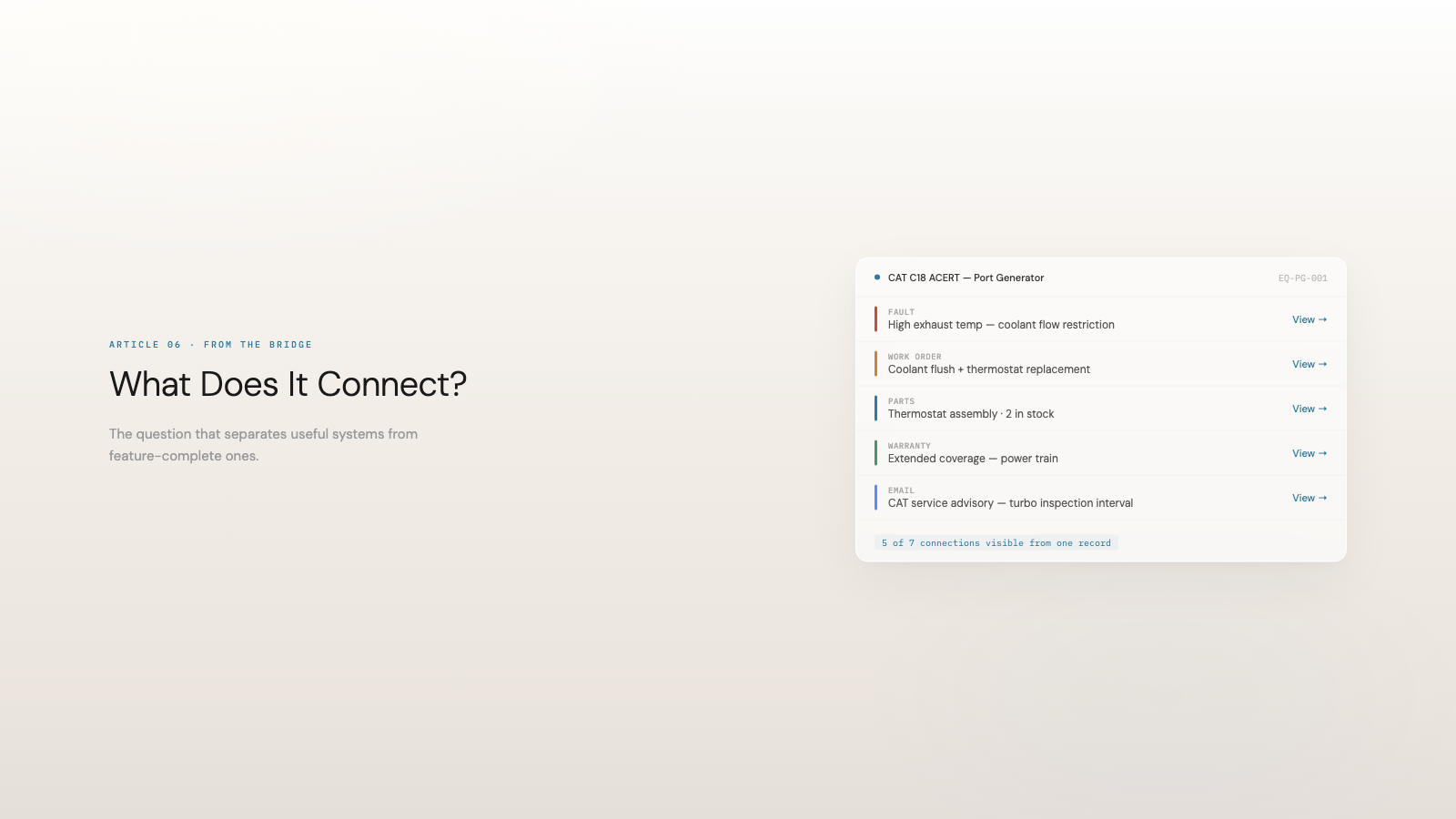
The question nobody asks when evaluating a yacht maintenance system
Every planned maintenance system on the market offers a maintenance module, a parts inventory, a document store, and some form of defect tracking. The feature lists are functionally identical. The differences between systems are not in what they have — they are in what they connect.
A system that has a maintenance module and a parts module is not necessarily a system where the maintenance module knows what is in the parts module. A system that has a fault log and a warranty tracker is not necessarily a system where logging a fault surfaces the warranty status of the affected equipment. Having both features and having them connected are two fundamentally different things.
The evaluation guides available to the industry — comparison articles, buyer checklists, "best PMS" roundups — ask the same questions: does it have scheduling? Does it support checklists? Can it track crew hours? These questions confirm that a system has the expected feature set. They do not reveal whether the system creates operational intelligence or stores data in parallel silos behind a shared login.
The question that matters is different: when an engineer opens a fault record, can they see the equipment's warranty status, the last three work orders on that equipment, the parts used in previous repairs, and the supplier correspondence about the component — without leaving the screen? If the answer requires opening another module, switching to another tab, or checking a spreadsheet, the system is siloed regardless of how many features it lists. Ask not what features it has — ask what it connects.
Seven connections every yacht maintenance system should make
The value of maintenance data is not in the records. It is in the connections between them. Seven specific connections determine whether a system produces operational intelligence or stores isolated records.
When a fault is logged against a piece of equipment, the system should immediately show whether that equipment is under warranty and what documentation the manufacturer requires to support a claim. An engineer should not need to check the warranty tracker separately to discover, after completing a repair at the vessel's expense, that the component was covered. The cost of missing this connection is a denied claim worth EUR 20,000 to EUR 100,000.
When a work order is completed and parts are consumed, the inventory should update automatically. If the part used was the last in stock, a reorder alert should trigger. If the part is on backorder, the next work order requiring it should reflect that. An engineer should never discover mid-repair that a critical component is out of stock because the work order system did not check.
When a fault is logged, the system should surface all previous fault records for the same equipment — not as a separate search, but as context presented alongside the current defect. A recurring failure that has been logged three times by three different engineers across two crew rotations should be visible as a pattern, not hidden as three isolated entries.
One view from a piece of equipment to every work order performed on it, every part consumed, every hour of labour logged, and the total cost of ownership over time. The maintenance schedule should know about the budget. An engineer who is about to authorise a EUR 4,000 repair should see that the quarterly maintenance budget has EUR 1,200 remaining — not discover it when the purchase order is rejected.
Supplier correspondence — technical advisories, quote confirmations, warranty terms, delivery schedules — is operational data. On most vessels, it lives in an email inbox that belongs to an individual crew member. When that crew member rotates off, the correspondence leaves with them. Email that relates to a work order or fault should be linked to that record, searchable by the next engineer, and preserved independently of any individual's account.
An expiring certificate should surface the equipment it relates to, any pending maintenance that must be completed before renewal, and the compliance deadline that drives the timeline. A certificate that expires in 45 days while a required maintenance task is scheduled for day 60 is a compliance failure waiting to happen — but only visible if the certificate, the equipment, and the maintenance schedule are connected.
The engineering handover should not be a document that the departing engineer assembles manually from memory and scattered records. It should be a compiled report generated from every domain — current equipment status, outstanding defects, parts on order, certificate expiry dates, budget status, and operational notes — automatically reflecting the actual state of the vessel at the moment of crew transition.
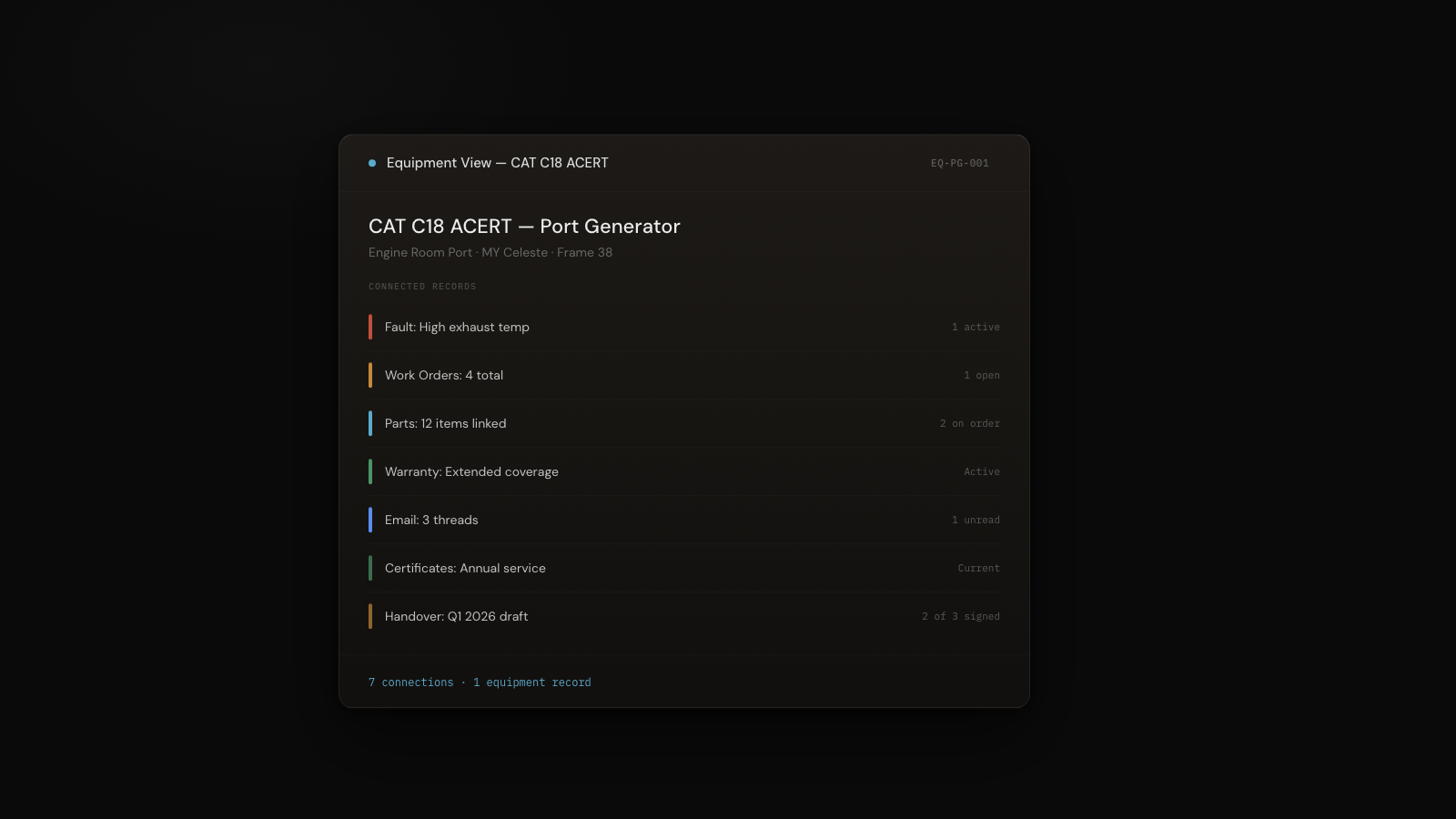
Why feature lists are misleading when comparing yacht maintenance systems
Having a maintenance module and a parts module and a documents module does not mean they are connected. Most systems store data in parallel silos with a shared login. The engineer can switch between modules without logging into a different application. This is a genuine improvement over spreadsheets. It is not cross-domain intelligence.
The difference is architectural. In a system with parallel modules, each module owns its own data. The maintenance module knows about maintenance. The parts module knows about parts. To connect a fault to a warranty period to a parts record to a supplier email, the engineer must perform the integration manually — opening each module, cross-referencing the records, and assembling the context in their head.
In a system with cross-domain connections, opening a fault record surfaces everything related to that fault: the equipment, the warranty, the parts history, the previous faults, the work orders, the supplier correspondence. The system performs the integration. The engineer makes decisions based on connected information rather than spending time assembling it.
That is not integration. It is the difference between integration and cohabitation.
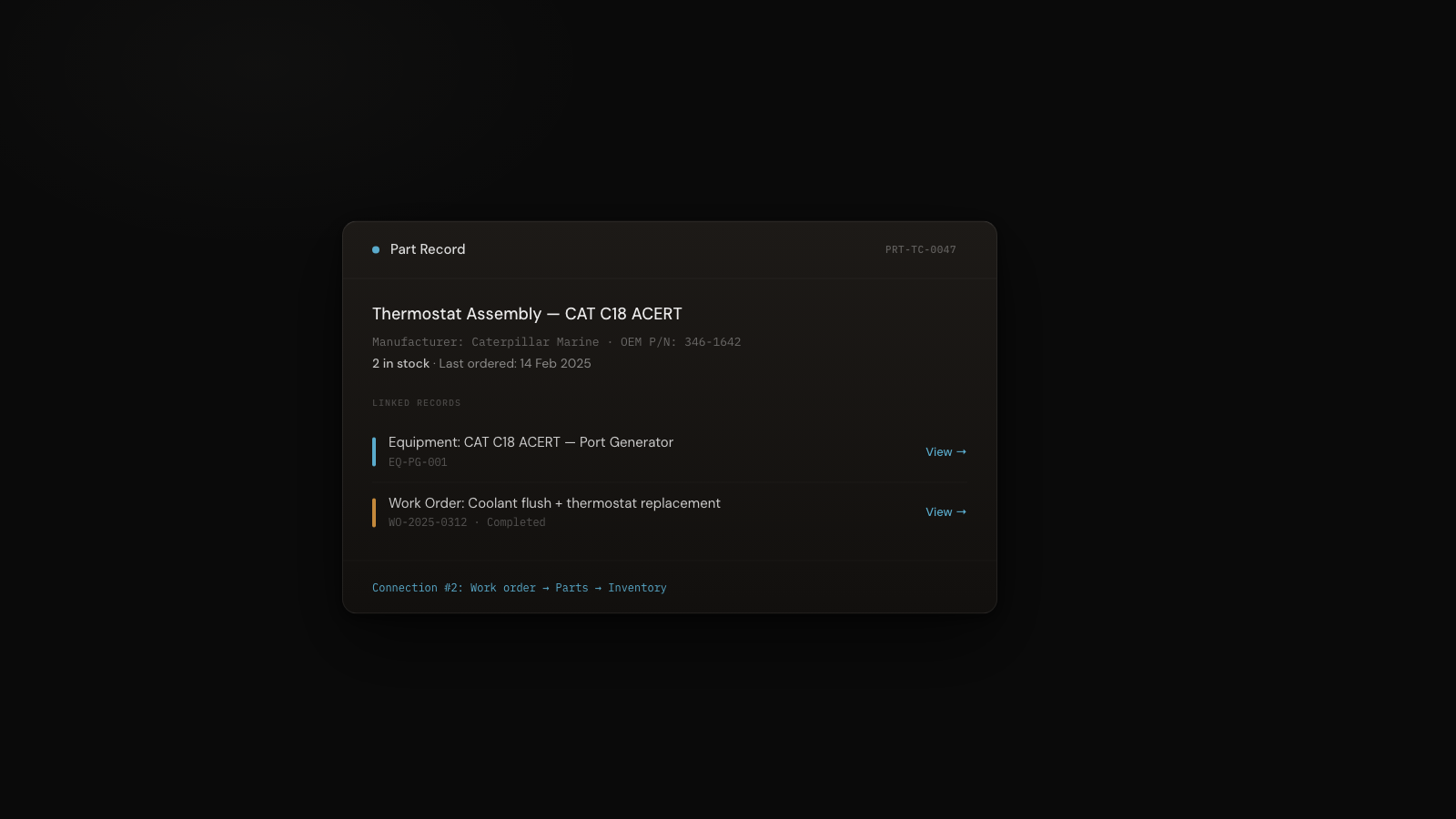
Part certainty — stock levels, supplier history, and linked equipment visible from a single record. The engineer knows what is aboard, what is on order, and which equipment depends on it.
What "search everything in one place" actually requires
The phrase "one platform" appears on every yacht maintenance software website. What it typically means is that all modules are accessible from a single login. What it should mean — and rarely does — is that a single search returns results across every domain.
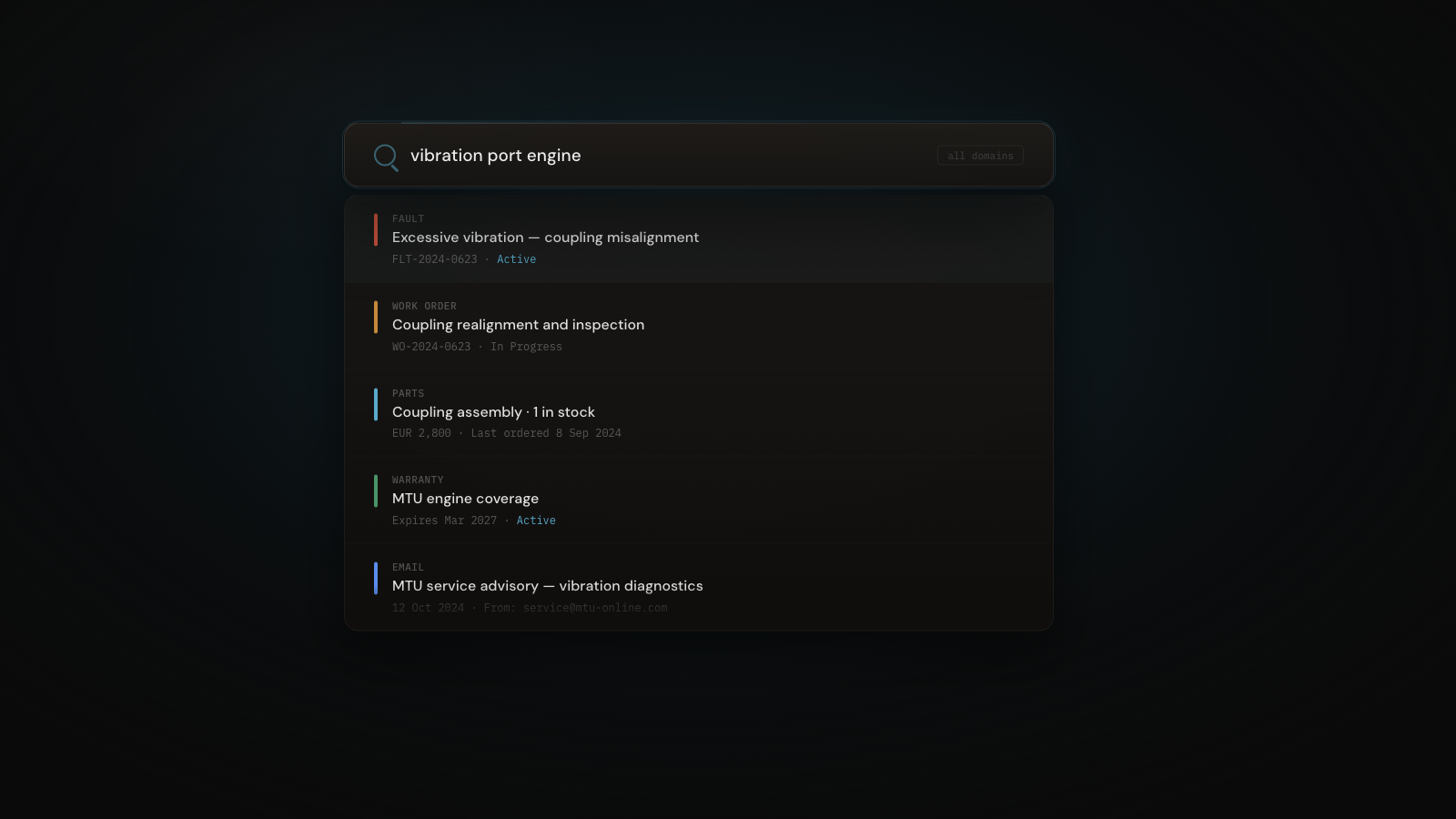
An engineer types "vibration port engine" into a search bar. A system that searches within the maintenance module returns matching work orders. A system that searches across domains returns the fault records, the work orders, the parts used in previous repairs, the equipment's maintenance history, the manufacturer's technical advisory, and the email thread where the shore-based technician described the diagnostic procedure.
The first system answers: "Here are the maintenance tasks that mention vibration." The second system answers: "Here is everything this vessel knows about vibration in the port engine." The difference between those two answers is the difference between a record-keeping tool and operational intelligence.
One search, every domain. A single query returning faults, work orders, parts, certificates, and supplier correspondence — the difference between searching within a module and searching across the vessel's entire operational knowledge.
How to evaluate any yacht maintenance system
The next time a yacht maintenance system is demonstrated, do not ask what features it has. Run this test instead.
Open a fault record. Without leaving the screen, without opening another module, without switching to a spreadsheet:
- Can you see the equipment's warranty status?
- Can you see the last three work orders on that equipment?
- Can you see the parts used in those work orders and the current stock level?
- Can you see the supplier who provided the parts and the relevant correspondence?
- Can you see whether a certificate depends on this equipment being operational?
If any of those answers require navigating to a different part of the system, the system has the features but not the connections. It is storing data, not creating intelligence.
Do not ask what features it has. Ask what it connects. The answer will tell you more than any feature list.
Summary
- Yacht maintenance systems are evaluated on feature lists — maintenance, inventory, documents, defect tracking — but the critical differentiator is not what features exist but what they connect to each other.
- Seven specific connections determine whether a system creates operational intelligence: fault to warranty, work order to parts, fault to history, equipment to cost, email to context, certificate to compliance, and handover to every domain.
- Most systems store data in parallel modules with a shared login — cohabitation, not integration. Cross-domain means the system assembles context so the engineer does not have to.
- The evaluation test is concrete: open a fault record and see if warranty, work orders, parts, supplier correspondence, and compliance deadlines are visible without leaving the screen.
- The question that separates useful systems from feature-complete ones: not "what does it have?" but "what does it connect?"
CelesteOS is a Maritime Technical Intelligence System for superyachts where every record — faults, work orders, parts, certificates, costs, and supplier correspondence — is connected across domains and searchable in a single query. Learn more at celeste7.ai.
[1] ONBOARD Magazine, "Planned Maintenance Software" — obmagazine.media
[2] Superyacht Content, "Planned Maintenance Systems, 5 Things To Know" — superyachtcontent.com