What a paper log book quietly loses
A maintenance log book does one job well: it records that something happened. The generator was serviced on a date, at an hour reading, by a named crew member. Kept on paper or in a spreadsheet, that entry is legible for exactly as long as the person who wrote it is aboard to explain it.
What the format cannot hold is the connection between entries. The vibration logged in March, the work order that chased it, the coupling that was re-aligned, the manufacturer bulletin cited in the fix — each is written down somewhere, but nothing ties them together. So when the fault returns eighteen months later under a new engineer, the vessel pays to diagnose it a second time. The information existed. It just wasn't findable.
The regulatory floor does not close this gap. The ISM Code requires vessels to keep records of maintenance and to inspect equipment at appropriate intervals [2]. That is a documentation minimum, not a retrieval standard: it requires that records exist, not that the next crew can search them, follow them, or trust them. And the next crew arrives soon — a Seahub industry survey found 66% of engineering handovers last one week or less [1]. The log book is often the only thing that persists across the change.
What a digital maintenance record has to carry
Going digital is not scanning the paper log and calling it done. A record that earns its place has to carry more than the event:
- The equipment it belongs to — so the entry lives on the machine's own history, not in a chronological blur.
- The reading and the date — running hours, the anomaly noted, what was actually observed.
- Who acted — attributed by signed-in user and role, and timestamped, so a year later there is no question who did what.
- The parts used — with the OEM number and where the replacement sits on board.
- The connections — the fault this closed, the work order it belonged to, the manual clause it followed.
That last item is the one paper cannot do and most spreadsheets never manage. A record that resolves back to the work behind it is worth more than a flat line of text describing the same event.
Parts are where this pays off first. Take an impeller kit for the seawater cooling pump: the digital record can show its shelf in the aft mooring locker, its stock against the minimum you set, the OEM part number and supplier, with a barcode and the work orders it was fitted on, all on the same record. The engineer stops guessing whether the spare is aboard and stops re-keying the part details.
How to move your log book to digital records
The migration is a consolidation, not a rewrite. Worked in this order, it stays manageable:
- Start from what you already keep. List every place a record currently lives — the planned-maintenance system, the noon log, the parts spreadsheet, the manufacturers' service bulletins, the folder of scanned certificates. Your existing manuals, PDFs, scans, and exports can be indexed as they are. There is no reformatting exercise to survive first.
- Fix what one record must contain. Agree the fields before you import anything: equipment, date, reading, who acted, parts used, and the short note that explains why — the workaround, the discontinued part, the torque figure that fails the gasket on this installation.
- Keep the connection, not just the entry. Link the fault to the work order that closed it, the work order to the part fitted, the part to the manual clause cited. The value is in the thread, not the individual beads.
- Make every entry attributable and append-only. Nothing should be overwritten. Corrections are recorded as new entries that reference the original, and the original stays intact. Records that can be quietly edited after the fact cannot serve as evidence when an auditor or a surveyor asks.
- Make it retrievable in plain language. The real test of a digital log is not how it looks on import day. It is whether the engineer who inherits the boat can ask a plain question and land on the record — without knowing where the last crew filed it.
- Import what you already have. Existing manuals, PDFs, scans, and exports come in as they are, with no reformatting.
Records you can actually ask a question of
Once the records are consolidated and connected, the difference shows up in how you retrieve them. Search lives at the top of every screen — phone, tablet, laptop. There is nothing to learn; the engineer types what they need, the way they'd ask a colleague, and the vessel's own records answer.
Ask for "oil" and the results come back grouped — the engine-room oil leak in faults, the oil filter stock in inventory, the oil-change procedure from the machinery manual. It finds what you mean, not what you typed, and it returns the record, not a snippet. Results are scoped to your vessel and role, so there is no filter to set up first.
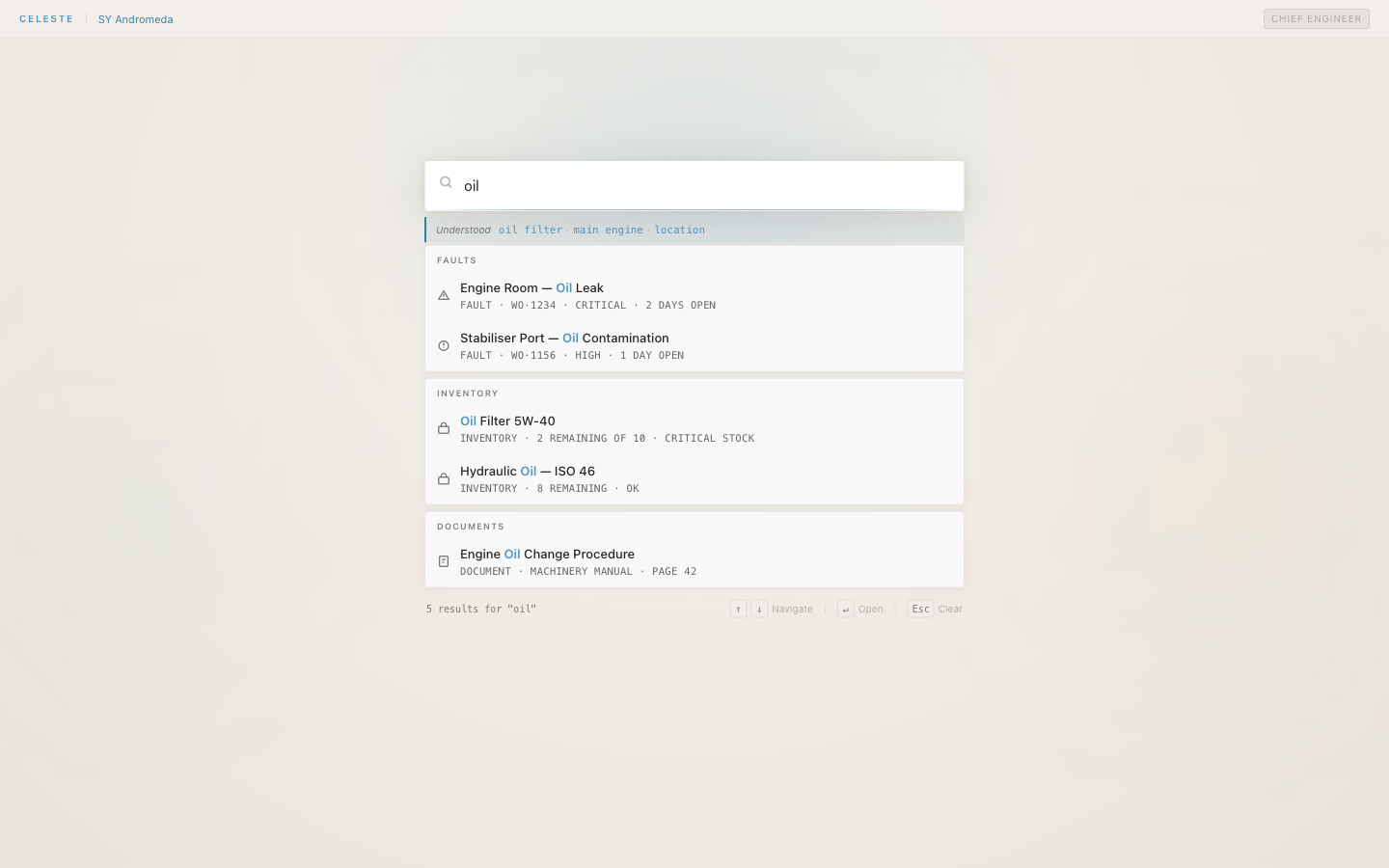
Every result is a live record. One click lands on the actual work order — status, history, parts. Results open the source record itself, so a plain question at 2am ends on the thing you needed, not a list of maybes. This is the same natural-language search across your vessel's records and manuals that a chief engineer would reach for mid-job; there is more on searching a vessel's records in plain language if that is the part you care about most.
Follow one record to the next
A digital log book earns its keep when one record leads to the others. Open a fault — a port fuel isolation valve leak under review — and what's related surfaces alongside it: the replacement work order, the valve assembly, the warranty claim. Show Related sits in every record's header, so the engineer stays oriented without leaving the page, and following one record leads to every connected record.
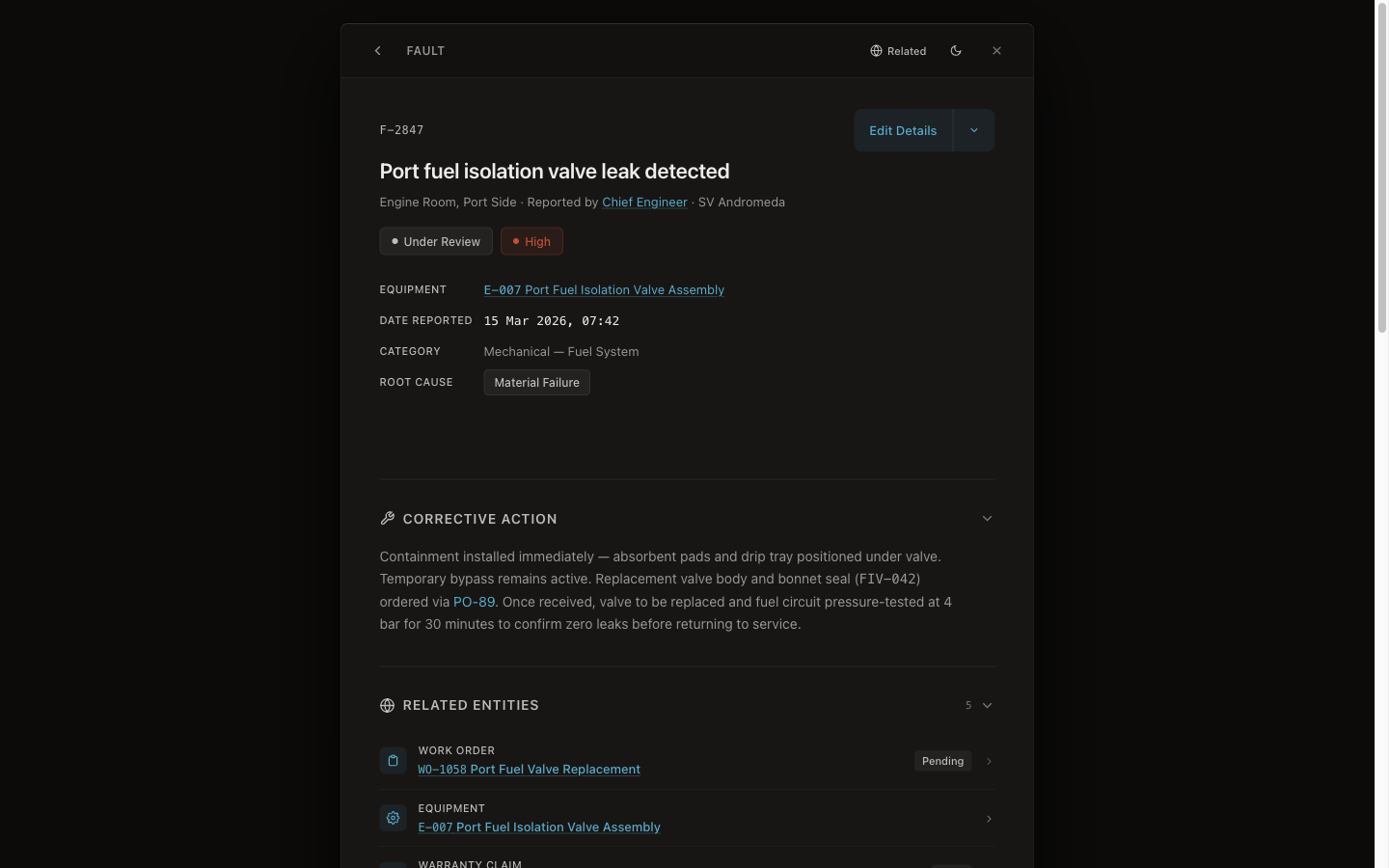
This is what carries a vessel across a crew change. The incoming engineer doesn't need the last chief's memory or filing habits — they open the record in front of them and let the connections lead. The judgement stays with the engineer; the record stays with the vessel. For the wider cost of losing that memory at every rotation, see what walks off the boat when the chief engineer leaves.
Proof, when someone asks
Digital records are only as good as their credibility on inspection day. Because the trail is append-only and every action is attributed and timestamped, audit prep becomes retrieval rather than assembly — you open the record and read its full history, who touched what and when. Each of those records is independently verifiable at verifier.celeste7.ai, so the vessel can show its work rather than assert it.
None of this is the tool doing your job. The system proposes; the engineer decides. What it changes is where the knowledge lives — captured as you work, connected, attributable, and searchable, so it stays with the boat instead of boarding a flight home.
Frequently asked questions
How can a paper yacht maintenance log be converted to digital records?
Start by mapping where records already live — the PMS, the noon log, parts spreadsheets, manufacturer bulletins, scanned certificates — then agree the fields one record must carry before importing. Existing manuals, PDFs, scans, and exports can be indexed as they are, so the move is a consolidation rather than a retyping exercise. The step most vessels skip is preserving the connections between entries, which is exactly what makes the digital version worth more than the paper one.
What should a digital maintenance record include?
The equipment it belongs to, the date and reading, who acted, the parts used with their OEM numbers and on-board location, and a short note explaining why the work was done the way it was. Critically, each record should resolve back to the fault, work order, part, and manual clause behind it, rather than sitting as an isolated line of text.
Do digital maintenance records satisfy the ISM Code?
The ISM Code requires that records of maintenance exist and that equipment is inspected at appropriate intervals. Digital records meet that floor comfortably, but the Code is a documentation minimum, not a retrieval standard — it does not require that records be searchable, connected, or transferable to the next crew. An append-only, attributed, timestamped trail is what turns a compliant record into one that also holds up as evidence.
Can existing records be brought into a digital log?
Yes. CelesteOS is the planned maintenance system, so the log, work orders, and equipment records sit in one place. Your existing manuals, PDFs, scans, and exports are imported as they are, and the vessel's records become searchable and connected.
Summary
- A paper or spreadsheet log records events but loses the connections between them — which is where a returning fault costs the vessel twice.
- The ISM Code sets a documentation floor, not a retrieval standard; findability and transfer are on you.
- A digital record earns its place by carrying the equipment, reading, actor, parts, and — above all — the links back to the work behind it.
- Move in order: consolidate what exists, fix the fields, keep the connections, make it append-only, make it searchable, and keep it in the planned maintenance system.
- The payoff is retrieval in plain language and one record leading to the next, so operational memory stays with the vessel across every rotation.
CelesteOS keeps a superyacht's maintenance records in the vessel — faults, work orders, parts, and manuals, connected and searchable in plain language, and independently verifiable at verifier.celeste7.ai. Learn about the pilot.
[1] Seahub, "Superyacht Engineering Handover: Good, Bad or Essential?" — seahubsoftware.com
[2] IMO, International Safety Management (ISM) Code, Section 10 — Maintenance of the ship and equipment — marineinsight.com