The admin work that consumes engineering time
On a superyacht with a conventional planned maintenance system, the act of recording work takes longer than the act of doing work. An engineer completes a repair and then spends time entering the same information into multiple places: the fault is closed in the defect log, the parts consumed are deducted from inventory, the work order is updated in the maintenance module, the equipment record is revised, and the handover notes are amended. Each entry is a separate task in a separate module.
The time spent on this administrative overhead is time not spent on the next maintenance task. More critically, it is time the engineer is likely to defer — logging records after the work, under time pressure, often at the end of a shift. Deferred logging becomes incomplete logging. Incomplete logging becomes documentation gaps. Documentation gaps become denied warranty claims, invisible fault patterns, and handovers that omit critical context.
The problem is not that engineers are unwilling to keep records. The problem is that keeping records requires more effort than it should.
What a cross-domain action looks like
A cross-domain action is a system-initiated suggestion that connects the current task to related records in other domains — without the engineer navigating to those domains manually.
In CelesteOS, actions are presented as contextual prompts at the moment they are relevant. The system does not act on its own. It proposes. The engineer decides.
Fault logged: "Create work order?"The engineer logs a fault on the port watermaker. The system recognises that a fault without a corresponding work order is an open loop. It offers to create the work order — pre-populated with the equipment reference, fault description, and department assignment. One confirmation. The work order exists, linked to the fault that generated it.
Work order created: "Check parts inventory?"The work order is created. The system identifies the equipment and surfaces the parts typically associated with watermaker membrane replacement. It shows current stock levels. If the membrane is in stock, the engineer proceeds. If it is not, the system shows the last supplier and order history. No inventory module navigation. No separate search.
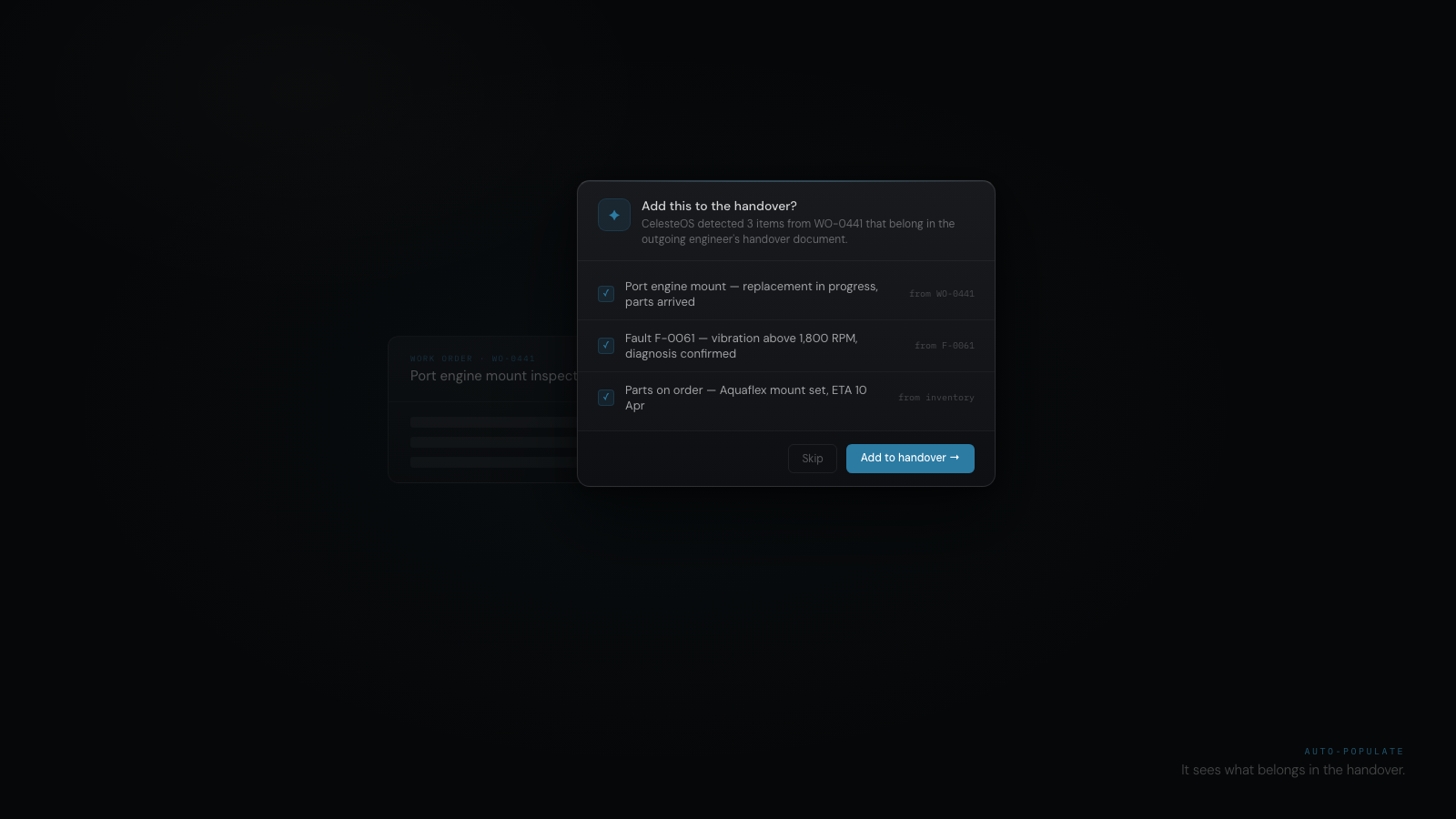
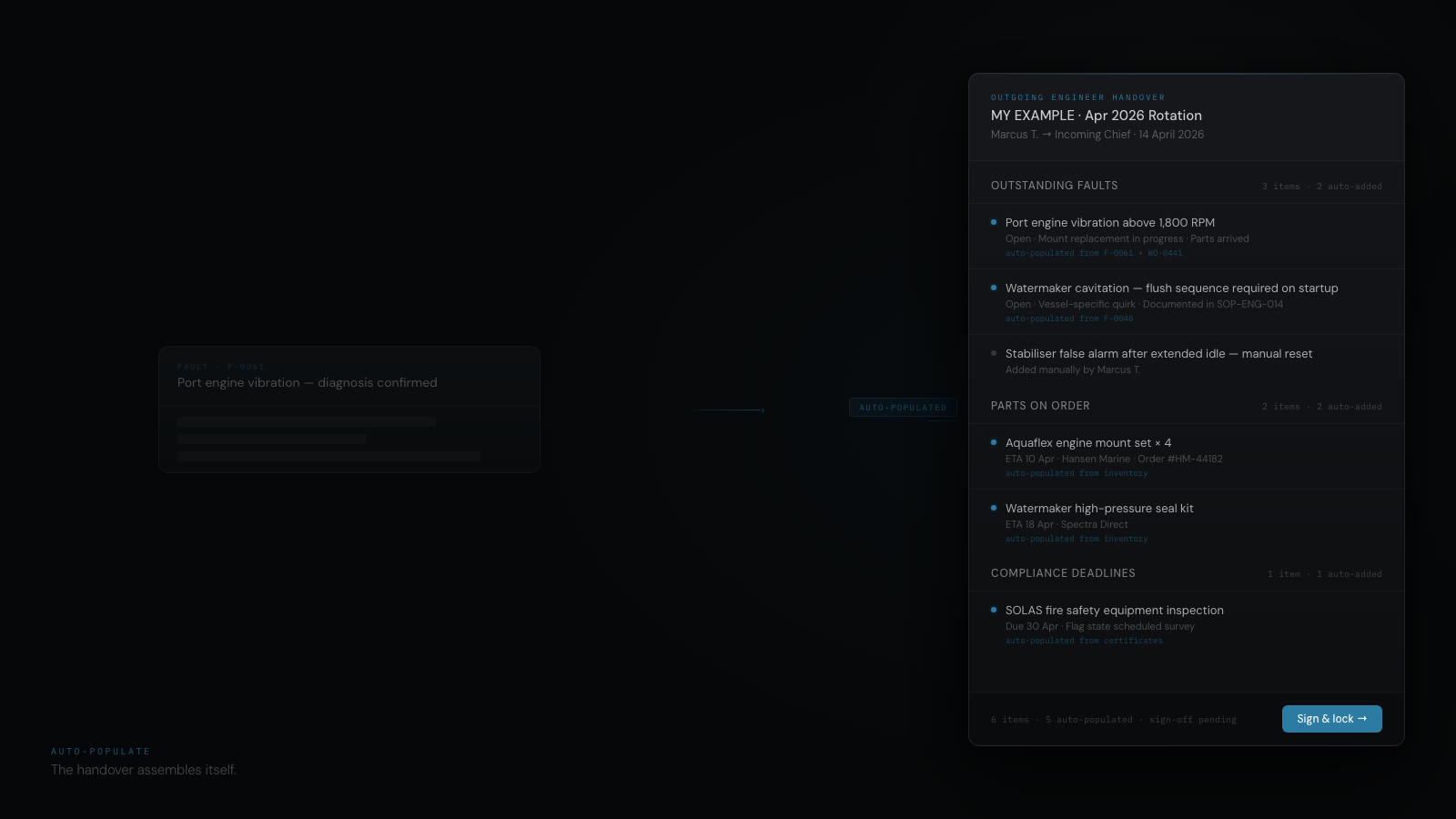
Fault with work order: "Add to handover draft?"The fault has a work order. Parts are on order. The system offers to add this item to the current handover draft — pulling the fault summary, work order status, and parts status into a single handover entry. The departing engineer does not need to remember to update the handover. The system proposes it at the moment the information is created.
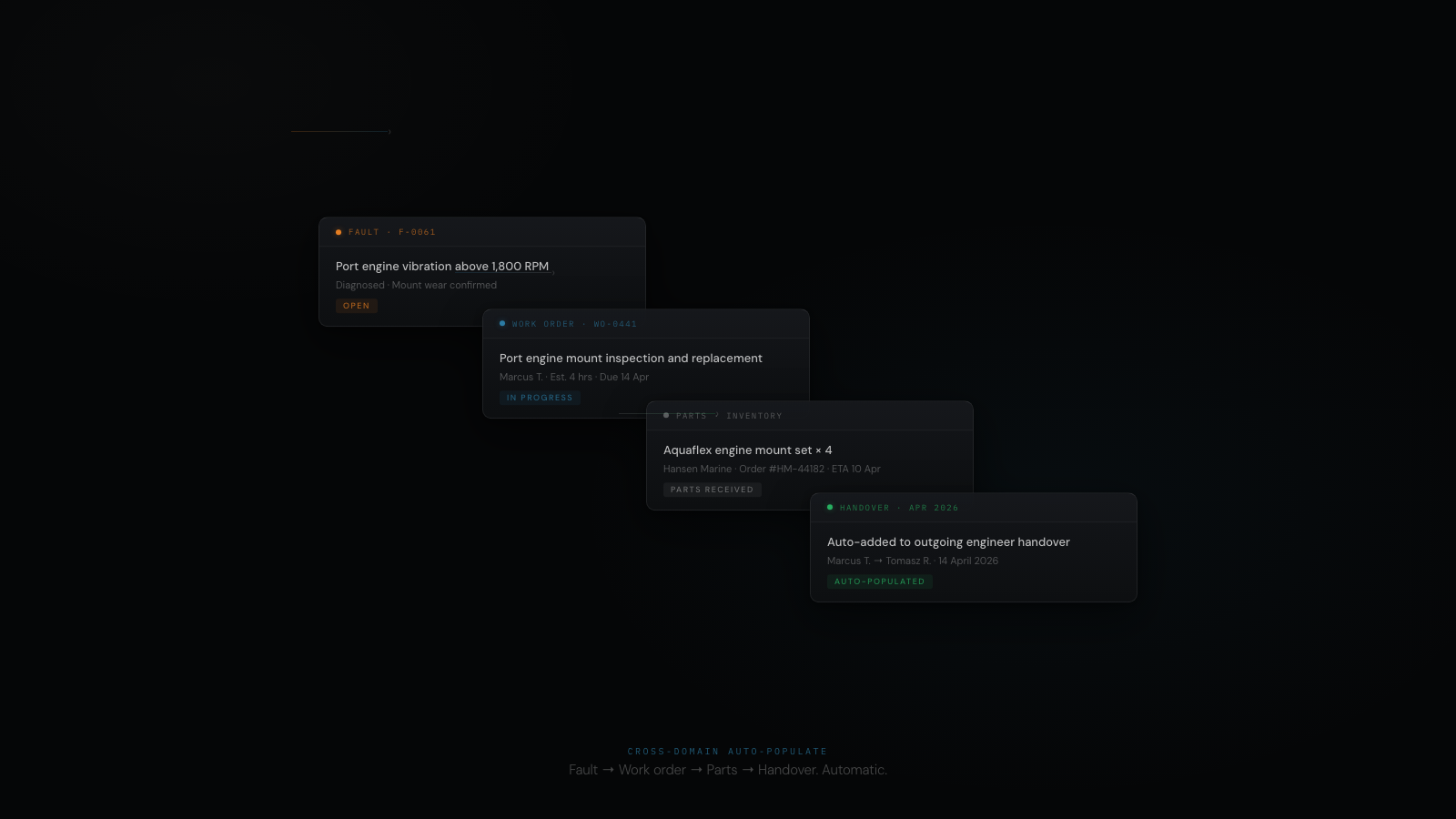
Each action is one click. Each action connects domains that would otherwise require separate navigation. Each action produces a linked record — the handover item links to the work order, which links to the fault, which links to the equipment, which links to the parts.
The system proposes, the engineer decides
Cross-domain actions in CelesteOS follow a strict rule: the system never executes an action without the engineer's explicit confirmation.
The system does not auto-create work orders. It does not auto-deduct parts from inventory. It does not auto-add items to handovers. It proposes the next logical step and waits for the engineer to confirm, modify, or dismiss.
This is a deliberate design decision, not a limitation. In regulated maritime operations, every action must be attributable to a named individual. Auto-execution removes attribution. It creates records that no one explicitly authorised — records that cannot withstand audit scrutiny because no person decided to create them.
The contextual prompt model preserves human judgment while eliminating the administrative friction that causes engineers to defer record-keeping. The engineer still decides. The system removes the navigation required to act on that decision.
What connected records look like
When cross-domain actions link records at the point of creation, several categories of administrative work disappear entirely.
Duplicate entry eliminatedThe fault description is written once. It populates the work order. The work order populates the handover item. The engineer does not type the same information three times in three modules.
Manual cross-referencing eliminatedThe incoming engineer does not need to search the fault log, then the maintenance module, then the parts inventory to understand the status of a repair. The records are linked from creation. Following one record leads to every connected record.
Forgotten handover items eliminatedItems are added to the handover draft at the moment they are created — not retrospectively, under time pressure, from memory. The handover assembles itself as the engineer works.
Orphaned records eliminatedA fault without a work order. A work order without parts. A repair without a handover entry. In systems without cross-domain actions, these gaps are common because creating the connection requires navigating to a different module and manually linking records. When the connection is proposed at the point of creation, orphaned records become the exception rather than the norm.
Handover auto-population
Article #6 in this series distinguished between integration and cross-domain connection. Integration means modules coexist within the same platform. Cross-domain means modules inform each other.
Cross-domain actions are where that distinction becomes operational. In an integrated system, the engineer can switch between the fault log and the parts inventory without logging in twice. In a cross-domain system, logging a fault surfaces the parts needed without the engineer switching at all.
The administrative overhead on a superyacht is not caused by bad software. It is caused by software that stores information in domains but does not connect them. Cross-domain actions close the gap between doing work and recording work — by making recording an extension of doing, not a separate task.
Summary
- Conventional yacht maintenance systems require engineers to enter the same information into multiple modules separately — fault log, work orders, inventory, compliance, handover — consuming engineering time and creating documentation gaps.
- Cross-domain actions are system-initiated suggestions that connect the current task to related records in other domains: "Create work order?" "Check parts inventory?" "Add to handover draft?" One click each.
- The system proposes, the engineer decides. No auto-execution. Every action is attributable to a named individual — essential for audit and regulatory compliance.
- Connected records eliminate duplicate entry, manual cross-referencing, forgotten handover items, and orphaned records.
- The result: recording work becomes an extension of doing work, not a separate administrative task deferred under time pressure.
CelesteOS is a Maritime Technical Intelligence System for superyachts where cross-domain actions connect faults to work orders, work orders to parts, and every record to the handover — proposed by the system, confirmed by the engineer. Learn more at celeste7.ai.
[1] BTM Group, "The Good and the Bad of Superyacht Software" — btmgroupci.com